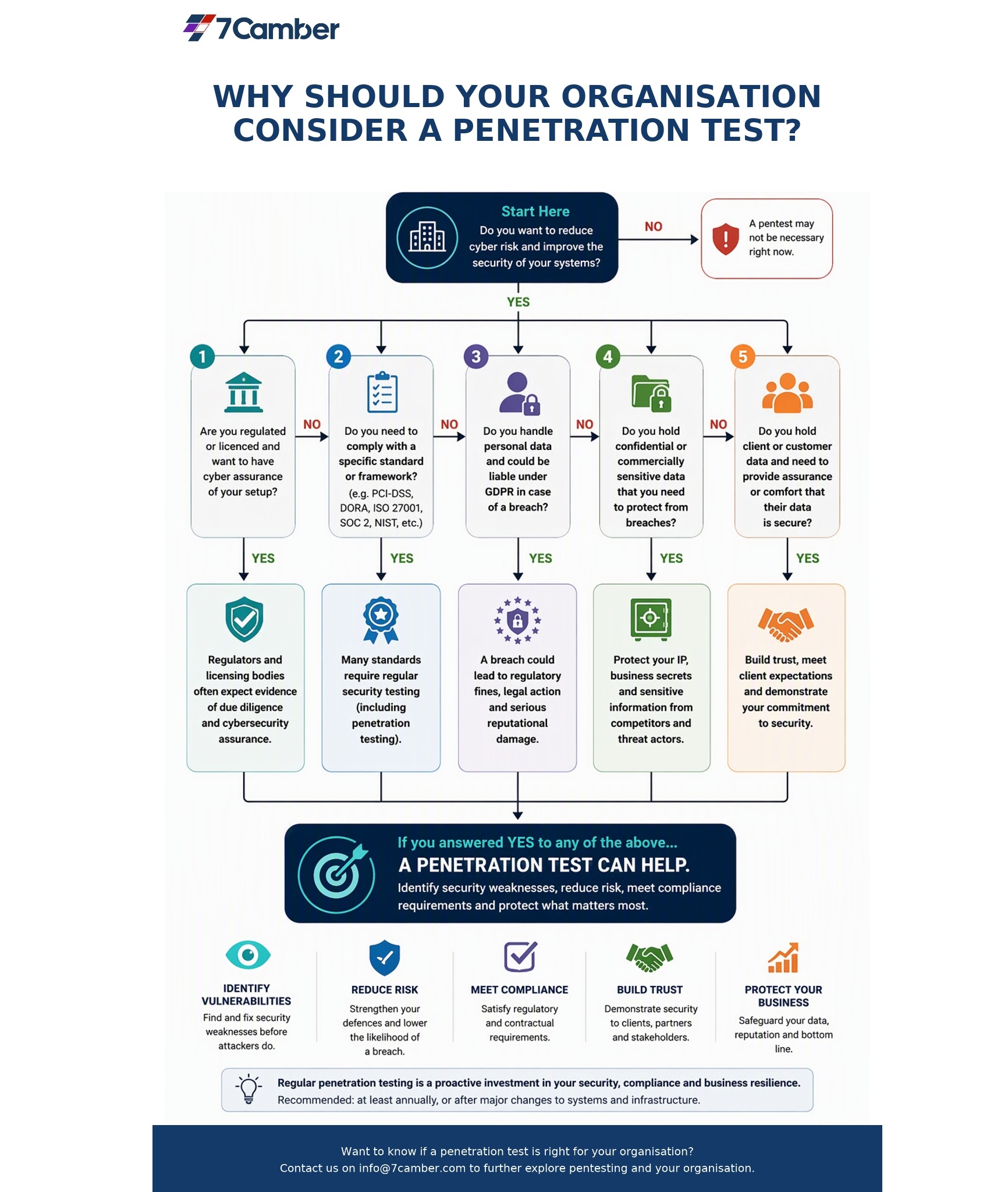
The fintech sector moves fast — faster than traditional finance, faster than regulation, and often faster than internal engineering teams can comfortably keep up with. Innovation is the heartbeat of the industry: instant digital payments, API‑driven banking, embedded finance, automated credit scoring, micro‑investing, digital onboarding, crypto custody, and more… all reasons to regularly pentest fintech setups.
But with innovation comes an uncomfortable reality: fintech is one of the most targeted industries for cyberattacks. Attackers love fintech because it combines everything they want — money, data, API integrations, third‑party dependencies, high‑value accounts, and a constant pressure to ship features quickly.
This is exactly why a pentest isn’t a “nice to have.”
It’s an operational, regulatory, and reputational necessity.
A fintech that doesn’t test its defences regularly is ultimately relying on hope — hope that developers didn’t miss something, hope that attackers don’t find a flaw first, hope that the controls from last year still stand up today.
Hope is not a security strategy. A structured, well‑executed pentest is.
The 10 Risks of Not Having a Pentest
When one does not pentest fintech setups, these top 10 risks manifest themselves:
1. Undetected Critical Vulnerabilities in Production
Without pentesting, vulnerabilities that attackers can exploit remain hidden — privilege escalation, logic flaws, broken authentication, insecure business workflows, insecure direct object references, and poorly secured APIs. For fintech companies, every one of these weaknesses represents a direct path to finandocial loss.
2. Breach of Customer Funds or Sensitive Financial Data
Fintech platforms store personal identifiable information, banking details, transaction histories, cardholder data, and sometimes crypto keys. If attackers compromise any of these, the resulting damage extends far beyond technical recovery — it undermines customer trust, which is extremely difficult to rebuild… another reason to pentest fintech setups.
3. Regulatory Non‑Compliance (and Heavy Fines)
Fintech firms operate under strict frameworks:
- PSD2 / PSR2 security requirements
- EBA ICT Guidelines
- DORA (Digital Operational Resilience Act)
- PCI‑DSS
- Local financial services regulations
- Data protection laws (GDPR)
Most of these frameworks explicitly require periodic pentesting or security assurance activities. In many cases, failure to pentest fintech setups can lead to non‑compliance, investigations, fines, or restrictions on operations.
4. Business‑Disrupting Security Incidents
A cyber incident doesn’t just impact systems — it impacts customers, cash flow, operations, investor confidence, and pending partnerships. For fintechs, downtime means immediate loss of trust and reputational capital.
5. Increased Fraud Risk
Fintech platforms are prime targets for automated fraud, account takeovers, API abuse, identity bypassing during onboarding, and synthetic identity fraud. If these weaknesses are not tested proactively, fraudsters will find and exploit them.
6. Poor Security Across Integrations and Third‑Parties
Fintech companies are deeply intertwined with the ecosystem — banks, payment gateways, KYC/AML vendors, identity providers, open banking APIs, and cloud services. Each integration is a potential attack surface, and without testing, weaknesses go unnoticed.
7. Security Debt Accumulating Over Time
As the codebase grows, new features can inadvertently introduce vulnerabilities. Without pentesting, this silent accumulation of risk becomes a ticking time bomb.
8. Loss of Partner and Investor Confidence
Partners want assurance. Investors want comfort. When a fintech cannot demonstrate that it has tested security rigorously, confidence drops — especially during audits, due diligence, or fundraising rounds.
9. Competitive Disadvantage
Security strengthens reputation. Fintech is fiercely competitive, and companies that invest in proper security testing differentiate themselves as trustworthy and resilient. Those who don’t get left behind.
10. Catastrophic Reputational Damage After a Breach
A single breach can undo years of brand‑building. Customers do not easily forgive fintechs that fail to protect their money or data.
The long‑term cost of a breach is almost always higher than the cost of ongoing pentesting.
The 10 Benefits of Carrying Out a Pentest
1. Clear Visibility of Real‑World Security Gaps
A pentest reveals how attackers would actually go after your platform — exposing weaknesses you didn’t know you had. This gives leadership a precise, evidence‑based understanding of risk.
2. Protection of Customer Data and Financial Assets
A good pentest strengthens your ability to protect your customers — their money, their personal data, and their transactions. This alone justifies the investment.
3. Stronger Regulatory and Audit Readiness
Whether it’s PSD2, DORA, PCI‑DSS, ISO 27001, or internal audit requirements, pentesting strengthens compliance posture. It provides documented, repeatable, third‑party validation of controls.
4. Reduced Likelihood of Fraud and Abuse
Testing for account takeover techniques, bypasses in onboarding flows, vulnerabilities in KYC/AML integrations, and weaknesses in transaction logic dramatically reduces fraud loss exposure.
5. Strengthened Confidence for Partners and Investors
When a fintech can confidently demonstrate recent pentesting, it sends a strong message:
“We take security seriously. We are resilient. We are in control.”
This supports due diligence, partnerships, and enterprise contracts.
6. Safer Innovation and Faster Feature Releases
With a routine pentest cycle, teams develop more confidence in their pipeline. New features are released with less fear of breakage, regressions, or unexpected weaknesses.
7. Improved Security Culture Across Engineering
Pentest findings create teachable moments. Developers learn real examples from their own platform, which reinforces secure coding practices and reduces future vulnerabilities.
8. Assurance Across APIs and Third‑Party Integrations
Pentests validate assumptions — insecure API endpoints, misconfigurations, incorrect scopes on OAuth tokens, unprotected webhooks, or unsafe integrations with financial institutions. This improves ecosystem security.
9. Prioritised, Actionable Remediation Roadmaps
A good pentest doesn’t just say “here’s what’s wrong.”
It tells you:
- what matters most
- how to fix it
- how urgent it is
- what the business impact could be
This clarity accelerates engineering productivity and reduces security burn.
10. A Stronger Brand Built on Trust
At the end of the day, fintech companies sell trust. Customers trust you with their money, their future, their identity. A well‑executed pentest contributes directly to brand strength, customer loyalty, and market credibility.
Why Fintech Needs a Different Level of Security Assurance
Fintech is not “just another software business.”
It’s a custodian of financial assets, a gateway to personal data and a traffic hub of highly sensitive transactions.
Because of this, fintech pentesting requires a more advanced, more specialised approach:
- Deep understanding of financial workflows
- Familiarity with payment schemes and settlement processes
- Testing for fraud vectors and account manipulation techniques
- Experience with API‑first architectures
- Awareness of regulatory obligations
- Ability to simulate real production attack patterns
- Familiarity with authentication, encryption, and session boundaries
- Understanding of fintech business logic and financial edge cases
Generalist pentesting is not enough. Fintech pentesting requires specialists who understand the domain.
What Makes a High‑Quality Fintech Pentest?
A strong pentest combines:
1. Realistic Attack Simulation
Testers should think like attackers — testing not just technical controls but business workflows and the paths real criminals would take.
2. Focus on Business Logic
Fintech attacks often bypass traditional vulnerabilities and target logic flaws:
- manipulating transfers
- bypassing spending limits
- altering exchange rates
- exploiting rounding logic
- forcing duplicate transactions
- escalating access through workflow gaps
3. Deep API Testing
Typically Fintech rely on and offer many APIs.
Testing them deeply is non‑negotiable.
4. Testing Across All Channels
Web apps, mobile apps, dashboards, admin portals, internal systems, and background jobs all need attention.
5. Secure Configuration and Cloud Posture
IAM misconfigurations, insecure storage buckets, key exposure, and breakdowns in cloud segmentation are common entry points.
6. Clear, Board‑Safe Reporting
Leadership needs risk clarity, not technical noise.
7. Actionable Remediation Guidance
The goal is not just to highlight risk it’s to reduce risk fast.
A Pentest Is Not Just About Security — It’s About Business Stability
Many fintech leaders focus on the technical benefit of pentesting, but the business‑level benefits are even more important:
- higher valuation
- stronger relationships with banks and partners
- credibility during enterprise sales
- reduced insurance premiums
- faster onboarding with large customers
- more confident and secure engineering culture
- protection of long‑term brand equity
A pentest is an investment in resilience, maturity and trust.
It is a forward‑looking approach to safeguarding the business you’ve built and the customers who rely on you daily.
The Strategic Mindset: Pentesting as a Core Part of Fintech Governance
Fintechs that treat pentesting as a strategic pillar — not a checkbox — typically experience:
- fewer incidents
- smoother audits
- stronger technical hygiene
- more confident scaling
- faster investor onboarding
- better operational resilience
- higher customer loyalty
Security becomes a competitive advantage and for fintech, that advantage is priceless.
Final Reflection: Fintech Leaders Must Ask Themselves One Question
Every fintech leader should reflect honestly:
“If attackers targeted us today, would we be confident in what they’d find? or terrified?”
Your answer to that question determines whether your business understands its real risk.
A pentest is the difference between reactive recovery and proactive protection, between uncertainty and assurance and between hope and resilience.
Fintech moves fast. Attackers move faster. Pentesting ensures you stay ahead.