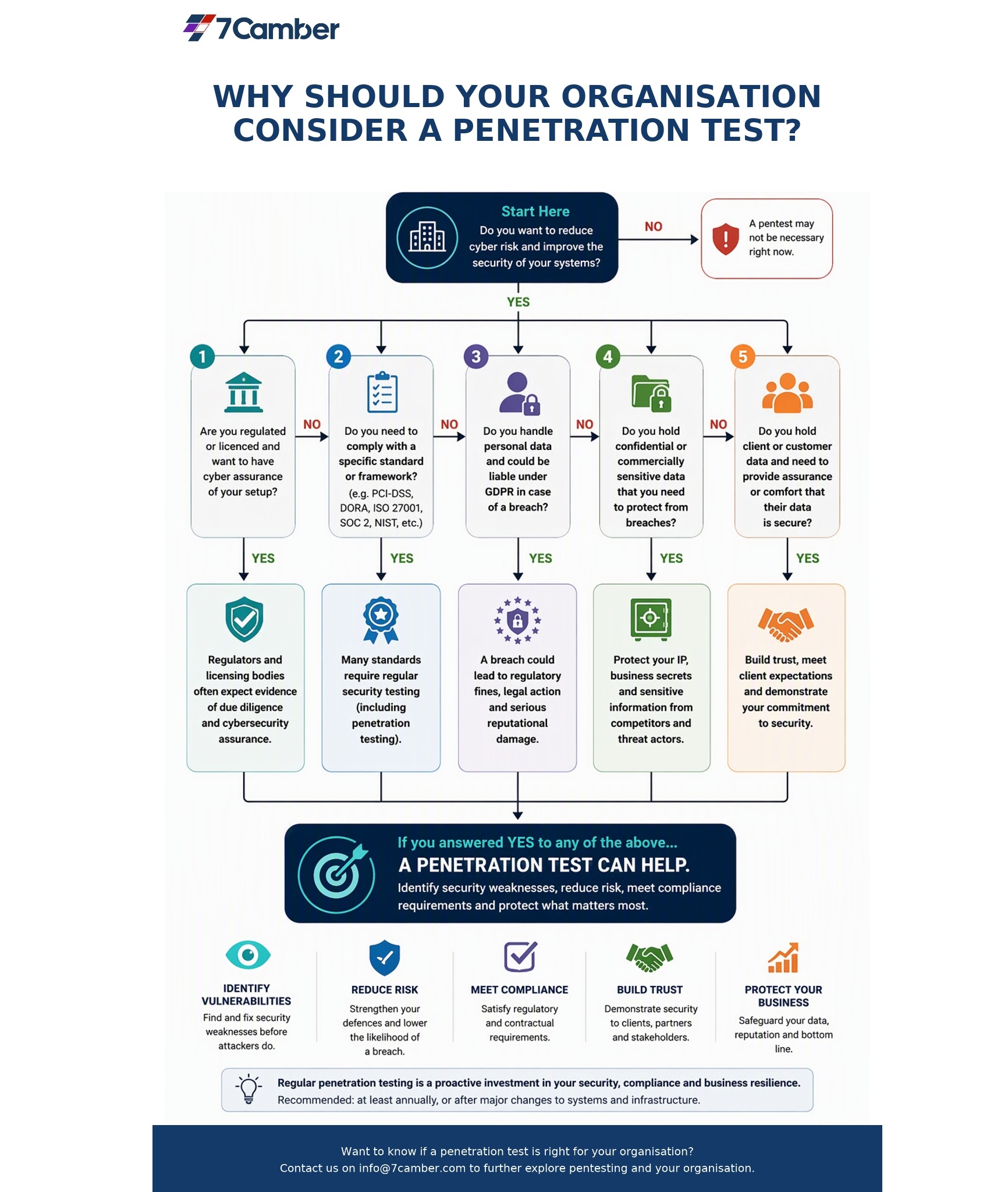
The European Court of Auditors recently published a special report examining how the European Union detects and responds to cybersecurity incidents. While the report focuses on cybersecurity at a policy and institutional level, its findings carry an important message for businesses of all sizes.
At its core, the report identifies familiar challenges: increasing cyber threats, difficulties in detecting attacks, delayed awareness of security incidents and gaps in visibility across interconnected environments.
These are not just problems for governments and large institutions. They are the same challenges faced every day by private organisations trying to protect their networks, applications and data.
For business leaders, CISOs and IT managers, the report reinforces a simple reality: cybersecurity controls cannot be assumed to work. They need to be tested, validated and continually improved. This is precisely where periodic penetration testing plays a critical role.
The Threat Landscape Is Not Standing Still
One of the key observations in the report is the growing complexity of today’s cybersecurity landscape. Digital transformation continues to increase the attack surface available to threat actors, while ransomware remains one of the most damaging and persistent threats facing organisations.
The challenge for businesses is that infrastructure changes constantly: New systems are deployed.,applications are updated, cloud services are added, employees change roles and third-party integrations are introduced.
A security assessment conducted three years ago reflects the risks that existed three years ago.
Periodic penetration testing provides an independent review of the current environment. It helps organisations identify weaknesses introduced through operational change and validates whether existing security controls remain effective against current attack techniques.
Cybersecurity is not a one-time project. It is an ongoing process of testing, learning and improving.
Detection Cannot Be Taken for Granted
Perhaps one of the most significant findings in the report is the apparent gap between reported incidents and the number of incidents identified through other sources of intelligence.
This highlights a challenge that security professionals have known for years: many organisations struggle to detect attacks taking place within their environment.
Modern security programmes depend heavily on technologies such as Security Information and Event Management (SIEM) platforms, Endpoint Detection and Response (EDR) tools and Security Operations Centres (SOCs). These technologies are valuable, but they are not infallible.
A well-executed penetration test does much more than identify vulnerabilities, it answers practical questions such as:
- Would an attack be detected?
- Would alerts be generated?
- Would security teams respond appropriately?
- How quickly could the organisation contain the threat?
If a penetration tester can move through the environment without being detected, a genuine attacker may be able to do the same.
Threat Intelligence Has Limited Value Without Validation
The report places strong emphasis on the sharing of threat intelligence, indicators of compromise and vulnerability information across organisations and member states.
Threat intelligence is an important component of a mature security programme. However, intelligence alone does not reveal whether a specific organisation is vulnerable.
When a new vulnerability is disclosed, every organisation faces the same question: “Does this affect us?” Penetration testing helps answer that question with evidence rather than assumptions.
By simulating real-world attack techniques, organisations can determine whether vulnerabilities are present, whether they are exploitable and what impact exploitation could have on business operations.
Knowing about a threat is useful however knowing whether that threat can compromise your environment is far more valuable.
Preparedness Is Always Cheaper Than Recovery
The report notes that most cybersecurity investment has been directed towards preparedness activities rather than incident response. This reflects a growing understanding across the cybersecurity industry: preventing incidents is significantly less expensive than recovering from them. The financial impact of a serious cyber incident can include:
- Business interruption
- Regulatory penalties
- Incident response costs
- Legal expenses
- Customer notification requirements
- Reputational damage
Periodic penetration testing helps organisations identify and remediate weaknesses before they become incidents. Every critical vulnerability discovered during a penetration test represents a potential breach that did not happen. From a business perspective, penetration testing should not be viewed as an expense. It is an investment in reducing organisational risk.
External Assessments Provide an Objective Perspective
A recurring theme throughout the report is the difficulty organisations face in understanding the true extent of their cybersecurity exposure. Internal teams often become familiar with their environments and their assumptions around security controls. This is entirely normal however, familiarity can sometimes create blind spots.
Independent penetration testing provides an objective view of an organisation’s security posture.
External testers bring fresh perspectives, attack methodologies and experience gained across multiple industries and environments. They evaluate security controls from the attacker’s perspective rather than the defender’s. This often reveals weaknesses that routine internal reviews fail to identify. The value lies not only in finding vulnerabilities but in validating whether risk assessments accurately reflect the organisation’s actual exposure.
Resilience Requires Continuous Testing
The strongest takeaway from the European Court of Auditors’ report is not that cyber threats are increasing. Most organisations already know that. The more important message is that visibility, detection and preparedness remain persistent challenges, even among highly resourced institutions.
For private organisations, the lesson is clear: Security controls should not be trusted simply because they exist. Detection capabilities should not be assumed simply because security tools have been deployed. Risk should not be estimated based solely on policies and documentation and it must be tested.
Periodic penetration testing provides organisations with a practical and measurable way to validate their defences, assess their readiness and improve their ability to detect and respond to real-world attacks.
In a threat landscape that continues to evolve at speed, regular testing is no longer a security best practice, it is a business necessity.
At 7Camber, we frequently find that the most valuable outcome of a penetration test is not the vulnerabilities themselves. It is the insight gained into how security controls, monitoring systems and response processes perform when subjected to realistic attack scenarios. Organisations cannot improve what they do not measure, and they cannot defend against threats they do not understand. Regular penetration testing provides that visibility and helps transform cybersecurity from assumption into assurance.