Many organisations invest heavily in cyber security. They deploy firewalls, endpoint protection, monitoring tools and staff awareness training. Yet one critical weakness is often overlooked: privilege escalation vulnerabilities.
In our experience as penetration testers, some of the most serious security findings are not the ones that allow initial access. Instead, they are the weaknesses that allow an attacker to expand that access and gain control of critical systems.
A seemingly harmless user account can quickly become the gateway to highly sensitive data, business systems and confidential information if privilege escalation vulnerabilities are present.
Understanding this risk is essential for business leaders who want to protect their organisation, reputation and bottom line.
What Is Privilege Escalation?
Privilege escalation occurs when an attacker gains a higher level of access than they should have.
Imagine a visitor enters your office reception area. On its own, this may not be a major concern. However, if that visitor finds a way to obtain a master key that opens every office, server room and records archive, the situation becomes significantly more serious. The same principle applies to IT systems.
An attacker may initially gain access through:
- A compromised password
- A phishing attack
- A vulnerable application
- An exposed remote access service
If privilege escalation vulnerabilities exist, that attacker may then obtain administrative rights and gain control of systems far beyond their original access level.
Why Business Leaders Should Care
Many security discussions focus on preventing an initial breach. While that remains important, modern cyber attacks often succeed because organisations fail to prevent attackers from moving further once inside.
The difference between a minor incident and a major security breach often comes down to privilege escalation.
When elevated access is obtained, attackers may be able to:
- Access confidential company data
- View sensitive customer information
- Disable security controls
- Deploy ransomware
- Create hidden accounts for persistent access
- Disrupt critical business operations
At that point, the financial and reputational impact can increase dramatically.
Examples from Real-World Penetration Testing
During penetration tests, we sometimes identify situations where an attacker could move from limited access to administrative control.
For example, we have seen environments where a standard user account could access files containing sensitive credentials. An attacker exploiting this weakness could potentially gain elevated rights and access systems far beyond those intended for a regular user.
In another scenario, a business had implemented a strong perimeter security. However, a configuration weakness allowed a low-level account to inherit excessive permissions. While the initial access itself posed limited risk, the inherited permissions could have enabled complete control of key systems.
We have also encountered organisations where outdated software remained in use on critical servers. Although the systems appeared secure on the surface, known vulnerabilities could have allowed an attacker to obtain administrative privileges.
None of these weaknesses resulted in actual breaches because they were identified and remediated through penetration testing. However, each represented a significant business risk.
The Hidden Cost of Undetected Privilege Escalation Vulnerabilities
The financial impact of a cyber incident is rarely limited to technical recovery.
The wider consequences may include:
- Operational downtime
- Lost productivity
- Regulatory investigations
- Customer notification costs
- Legal expenses
- Reputational damage
- Loss of customer trust
- Increased cyber insurance premiums
In many cases, organisations spend considerably more responding to an incident than they would have spent identifying and fixing the underlying vulnerability.
This is one reason why proactive security testing delivers significant value. The cost of remediation before an attack is almost always lower than the cost of recovery afterwards.
How Penetration Testing Identifies These Risks
A professional penetration test goes beyond searching for obvious vulnerabilities. Experienced testers examine how an attacker could progress through an environment after gaining initial access. The objective is not simply to identify a weakness. It is to understand the potential business impact if that weakness were exploited.
A thorough assessment helps answer critical questions:
- Could a low-level user gain administrative access?
- Are sensitive systems adequately protected?
- Can access controls be bypassed?
- Are privileged accounts properly secured?
- Does the organisation follow the principle of least privilege?
By simulating realistic attack paths, penetration testing provides a clear picture of the risks that matter most to the business.
Reducing the Risk of Privilege Escalation
While every environment is different, several measures consistently reduce the likelihood of privilege escalation.
These include:
- Apply the Principle of Least Privilege – Users and systems should only have access to the resources required for their role.
- Excessive permissions create unnecessary opportunities for attackers – Review Privileged Accounts Regularly
- Administrative accounts should be regularly audited to ensure they remain necessary and appropriately controlled.
- Patch and Update Systems Promptly – Many privilege escalation vulnerabilities arise from known software weaknesses for which fixes already exist.
- Secure Sensitive Credentials – Passwords, access keys and other credentials should never be stored in locations accessible to unauthorised users.
- Conduct Regular Penetration Testing – Independent testing helps identify weaknesses before attackers do and provides assurance that security controls are working as intended.
The Business Value of Penetration Testing
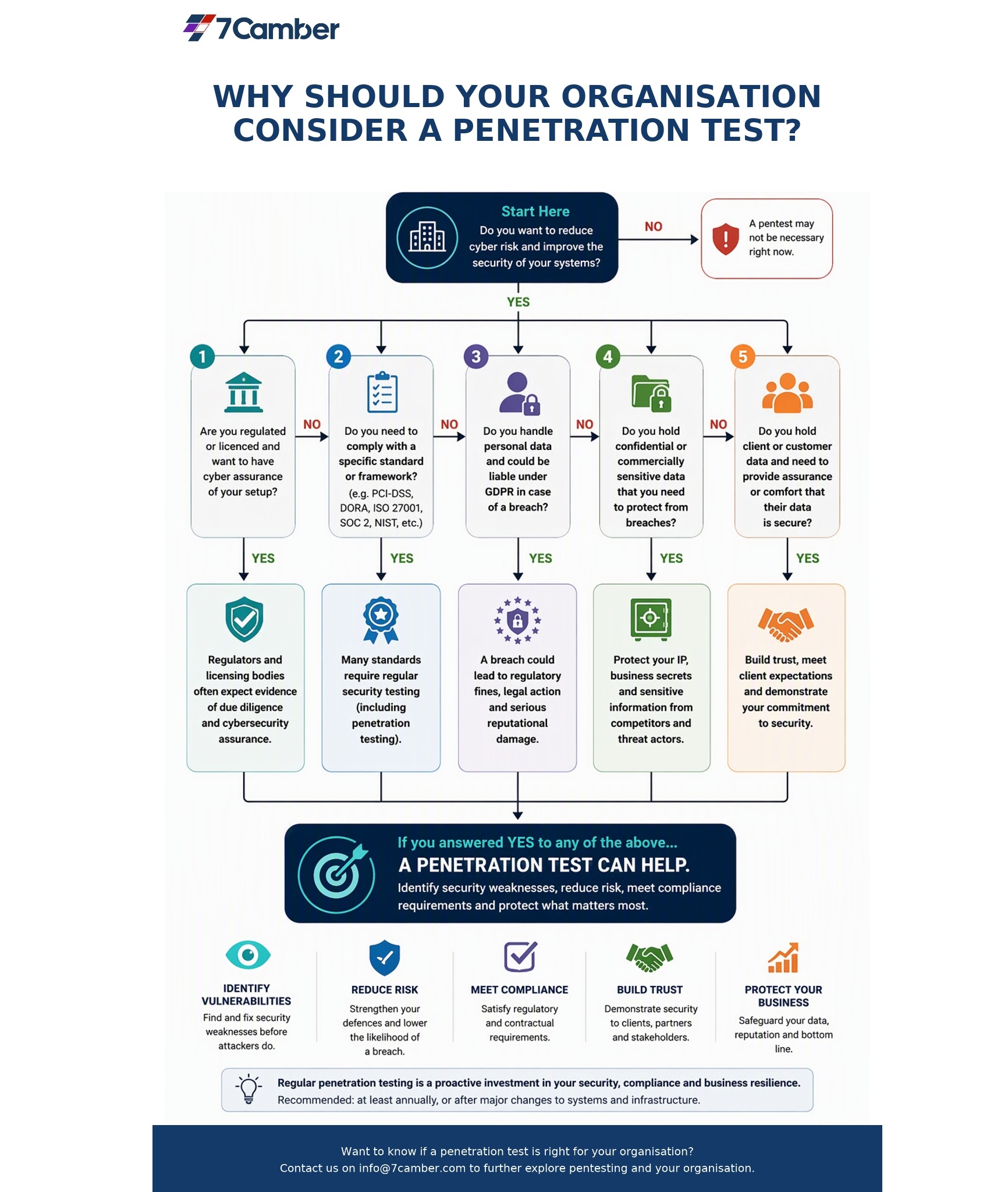
For business leaders, penetration testing is not simply a technical exercise, it is a strategic risk management activity.
Identifying privilege escalation vulnerabilities can help organisations:
- Reduce the likelihood of a serious breach
- Avoid costly operational disruption
- Strengthen regulatory compliance
- Protect customer trust
- Improve cyber resilience
- Prioritise security investment effectively
Most importantly, penetration testing provides evidence-based insight into how an attacker could impact the organisation and how those risks can be reduced.
Final Thoughts
Privilege escalation vulnerabilities are among the most dangerous weaknesses we encounter during penetration tests. While they may not attract the same attention as external attacks or phishing campaigns, they often determine whether an attacker remains a minor nuisance or becomes a major business threat.
For organisations seeking to strengthen their cyber resilience, identifying and remediating privilege escalation vulnerabilities should be a priority.
The question is not simply whether an attacker can gain access. The critical question is what they could do next.
That is precisely where professional penetration testing delivers its greatest value.