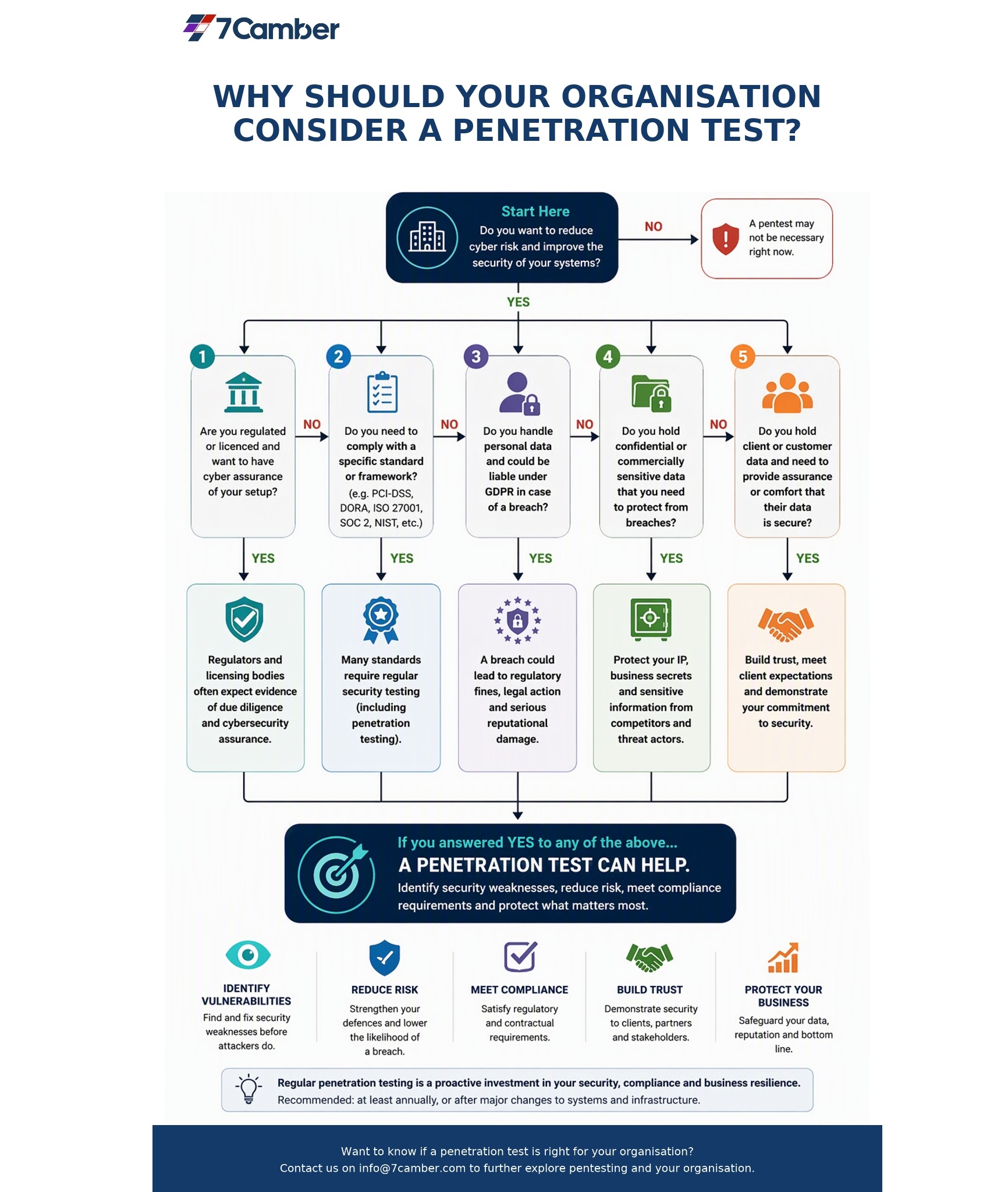
Trust, Assurance, and Audit‑Ready Evidence (Without Disrupting Delivery)
Service providers sit at the centre of the payment ecosystem. Your merchants, partners, and assessors don’t just want to hear that you take security seriously … they want evidence that your controls work under real attack conditions. PCI DSS Penetration Testing is one of the most direct ways to produce that evidence because it validates exploitable paths into the Cardholder Data Environment (CDE), confirms whether segmentation is truly effective, and provides documentation that supports compliance and customer assurance.
This article is written specifically for service providers (payment gateways, PSPs, hosting providers, SaaS platforms handling CHD, and vendors in scope for PCI DSS). It explains what PCI penetration testing should cover, how to run it smoothly, and what high‑quality reporting looks like when your goal is trust, peace of mind, and fast remediation. PCI’s own penetration testing guidance emphasises clear scope definition, a structured methodology (pre‑engagement → engagement → post‑engagement), and robust reporting and documentation.
Why PCI DSS Penetration Testing Matters More for Service Providers
For service providers, PCI isn’t only about securing your environment. It’s about protecting your customers’ trust and proving that your platform, isolation, and operating model reduce the likelihood of cross‑tenant impact, data exposure, and systemic payment risk. PCI penetration testing is designed to determine whether and how a malicious actor could gain unauthorised access to systems and potentially cardholder data, and to confirm that PCI‑required controls, including segmentation, are in place and effective.
That difference matters because service providers often have:
- Shared infrastructure and multi‑tenant platforms, where isolation is a core security claim. (Service‑provider environments make segmentation validation and access control testing especially important, because PCI guidance treats segmentation checks as a component of penetration testing.)
- Large attack surfaces, including portals, APIs, remote access, admin tooling, and support access paths. (PCI guidance expects both application-layer and network-layer testing, including external and internal perimeters.)
- Rapid change, driven by CI/CD, cloud adoption, and integrations—each change can introduce new pathways that only show up in real testing. (PCI guidance discusses significant changes and the need for methodical pre‑engagement planning and documentation.)
PCI DSS Penetration Testing converts “we believe we are secure” into “we can demonstrate we are secure.”
PCI DSS Penetration Testing vs Vulnerability Scanning (Why the Distinction Matters)
PCI explicitly distinguishes penetration testing from vulnerability scanning. A scan is usually automated and focused on identifying and ranking known vulnerabilities; PCI penetration testing is a manual process that aims to exploit vulnerabilities to circumvent security features and demonstrate real attack paths and impact.
For service providers, this distinction is essential because your highest‑risk issues often don’t look like obvious “scanner findings.” They look like:
- broken authorisation across tenants,
- misconfigured identity roles and trust policies,
- privilege escalation routes via admin tooling,
- unsafe support workflows,
- security control bypasses through edge services.
A good PCI test uses tools, of course, but relies on human judgement, chaining, and validation to prove what is actually exploitable in your environment. PCI’s guidance frames penetration testing as a manual process that may incorporate scanning tools but results in a comprehensive report.
What PCI DSS Penetration Testing Should Cover (Service Provider Lens)
PCI’s guidance sets the foundational expectations:
- Scope includes the entire CDE perimeter and any critical systems, covering both external and internal perimeters.
- Testing includes both application-layer and network-layer assessments.
- Segmentation checks are explicitly part of penetration testing components.
- PCI pentests are typically grey-box or white-box to achieve more accurate and comprehensive results than pure black-box testing.
Below is how those requirements translate to real service-provider testing.
1) External perimeter testing: “What can the internet reach?”
PCI guidance describes external penetration testing as targeting the exposed external perimeter of the CDE and critical systems accessible from public network infrastructures, and notes that it must include application-layer and network-layer testing.
For service providers, that typically includes:
- Public portals (customer, merchant, admin, support)
- Public APIs (payments, tokenisation, webhooks, admin APIs)
- Remote access services (VPNs, bastions, identity endpoints)
- Edge services (WAF/CDN config where applicable, TLS posture)
- Credential-based entry points (authentication flows, SSO)
This aligns well with 7Camber’s broader approach to external testing: internet-facing services are continuously probed, and even a single misconfiguration, weak credential, or vulnerable exposure can become an entry point: so the goal is exploitable weakness validation and clear remediation guidance.
2) Internal testing: “Assume a foothold: can an attacker reach the CDE?”
PCI expects internal perimeter coverage as part of the penetration testing scope for the CDE and connected critical systems.
For service providers, internal testing often focuses on:
- paths from corporate networks to production environments,
- privilege escalation via misconfigurations,
- secrets access and credential reuse risks,
- service-to-service trust pathways,
- operational tooling that can “bridge” into sensitive systems.
Even if you believe your segmentation is strong, internal testing is what proves whether that belief holds in practice. PCI’s guidance treats segmentation checks and scope validation as core elements.
3) Segmentation and isolation validation: “Can we prove scope reduction and tenant separation?”
Segmentation checks are specifically included as a penetration testing component in PCI guidance.
For service providers, segmentation isn’t just VLANs and firewall rules. It may include:
- network segmentation across environments (prod vs non‑prod),
- management plane isolation,
- identity and privilege boundaries,
- tenant isolation controls in application logic.
This is often the difference between an easy audit and a painful one: you want test evidence that your segmentation is operational and effective, not just documented. PCI’s guidance consistently links penetration testing to confirming the presence and effectiveness of relevant controls.
4) Application-layer testing: “Do workflows and access controls fail under attack?”
PCI guidance explicitly covers application-layer testing and provides terminology for different testing approaches (grey-box/white-box etc.).
Service providers should expect testing depth on:
- authentication and session management,
- access control and authorisation checks (including cross‑tenant),
- business logic exploitation,
- API data exposure and abuse controls,
- integration trust boundaries.
If you’re a gateway/PSP, your risk isn’t just a SQL injection: it’s often a subtle authorisation flaw that lets one tenant query another tenant’s data through an edge case, or a privilege pathway via a support tool. A PCI‑aligned test should be capable of identifying those real‑world routes.
The “Smooth Flow” Engagement: How to Run PCI Testing Without Stress
PCI’s penetration testing guidance is structured around pre‑engagement, engagement, and post‑engagement, with emphasis on documentation, rules of engagement, and reporting.
A smooth engagement should feel predictable: especially for service providers with always‑on platforms.
Phase 1 — Pre‑engagement: scope clarity + rules of engagement (no surprises)
PCI explicitly calls out scoping, documentation, and rules of engagement as pre‑engagement considerations.
For service providers, this phase should lock down:
- CDE boundary and “critical systems” that can impact the CDE
- Testing approach (usually grey-box/white-box for accuracy in PCI contexts)
- Operational guardrails (rate limits, safe windows, no‑go activities)
- Escalation paths and stop/go criteria
- Access and test accounts (especially important for SaaS/API testing)
This is where a partner’s communication style matters. 7Camber positions itself around clarity and the ability to communicate with technical teams while translating risk into business terms—exactly what you want when engineering, compliance, and leadership must align quickly.
Phase 2 — Engagement: controlled realism (prove impact, don’t cause outages)
PCI states penetration testing is a manual process that may include automated tools, and aims to identify exploit paths and validate controls.
For service providers, “controlled realism” means:
- testing that simulates real attacker behaviour,
- but with clear guardrails to protect platform stability,
- and fast communication if unexpected behaviour is discovered.
Phase 3 — Post‑engagement: reporting + remediation support + retesting
PCI’s guidance includes reporting guidelines and retesting considerations, which strongly implies the report must be complete enough to guide remediation and evidence the work performed. A smooth engagement ends with:
- a clear, prioritised report,
- a remediation working session (optional but valuable),
- and retesting to confirm fixes and close findings cleanly.
What “Good” PCI Reporting Looks Like (Peace of Mind in Document Form)
PCI’s penetration testing guidance devotes an entire section to reporting and documentation and includes report outline considerations.
In practice, a high-quality PCI DSS Penetration Testing report should serve three audiences:
1) Engineering: actionable, reproducible, prioritised
A strong report includes:
- step-by-step reproduction,
- evidence (screenshots, request/response samples where appropriate),
- affected components,
- practical remediation guidance,
- prioritisation based on real-world exploitability and impact.
This aligns with 7Camber’s emphasis on practical guidance and clarity over complexity.
2) Compliance/QSA: scope and method evidence you can defend
PCI expects scope clarity (CDE perimeter and critical systems) and rules of engagement, plus reporting structure and documentation that demonstrates what was tested and how.
For service providers, your report should clearly show:
- the agreed scope and boundaries,
- how segmentation was validated,
- what internal and external perspectives were tested,
- what assumptions and access levels were used.
3) Leadership & customers: confidence without fear, clarity without jargon
Service providers often need an executive summary that supports:
- risk understanding,
- resourcing remediation,
- customer assurance (sometimes via a sanitised summary).
7Camber’s positioning includes translating technical risk into actionable business insights—this is exactly what leadership-level reporting requires.
Common Pain Points for Service Providers (and How PCI Testing Solves Them)
Pain point 1: “We need customer assurance—without oversharing”
PCI DSS Penetration Testing helps you build a credible assurance narrative because it produces evidence that your controls work under realistic attack conditions. PCI’s guidance links penetration testing directly to validating controls and determining whether attackers can gain unauthorised access.
Pain point 2: “Our platform changes fast—how do we stay confident?”
PCI’s guidance addresses significant changes and strongly frames testing as part of a structured security validation approach (scope, method, documentation, reporting). A mature service provider uses PCI testing not only annually, but strategically: after major architectural or integration changes … because that’s when new paths appear.
Pain point 3: “We rely on segmentation—can we prove it?”
Segmentation checks are a defined component of PCI penetration testing. If your service provider model relies on segmentation (or tenant isolation) to reduce scope or risk, validation is non‑negotiable.
Pain point 4: “We dread pentests because they disrupt delivery”
PCI emphasises rules of engagement and agreed scope boundaries; a professional engagement uses these principles to keep the test controlled and safe for always‑on environments.
Conclusion: PCI DSS Penetration Testing as a Trust Engine
For service providers, PCI DSS Penetration Testing is more than a compliance step. It’s one of the best ways to demonstrate that your platform and operating model deserve trust—because you’ve tested them as attackers would, validated that controls hold, and documented everything clearly enough to support audits and customer assurance. PCI’s own guidance emphasises scope accuracy, segmentation validation, structured methodology, and strong reporting as essential components of a credible penetration test.
When done well, the engagement feels calm and professional: clear scoping, controlled execution, and reporting that drives quick remediation. That’s what creates peace of mind—not just for your internal stakeholders, but for the customers who depend on you. 7Camber’s positioning aligns to that outcome: proven expertise, clarity, and actionable insights that support confident decisions.