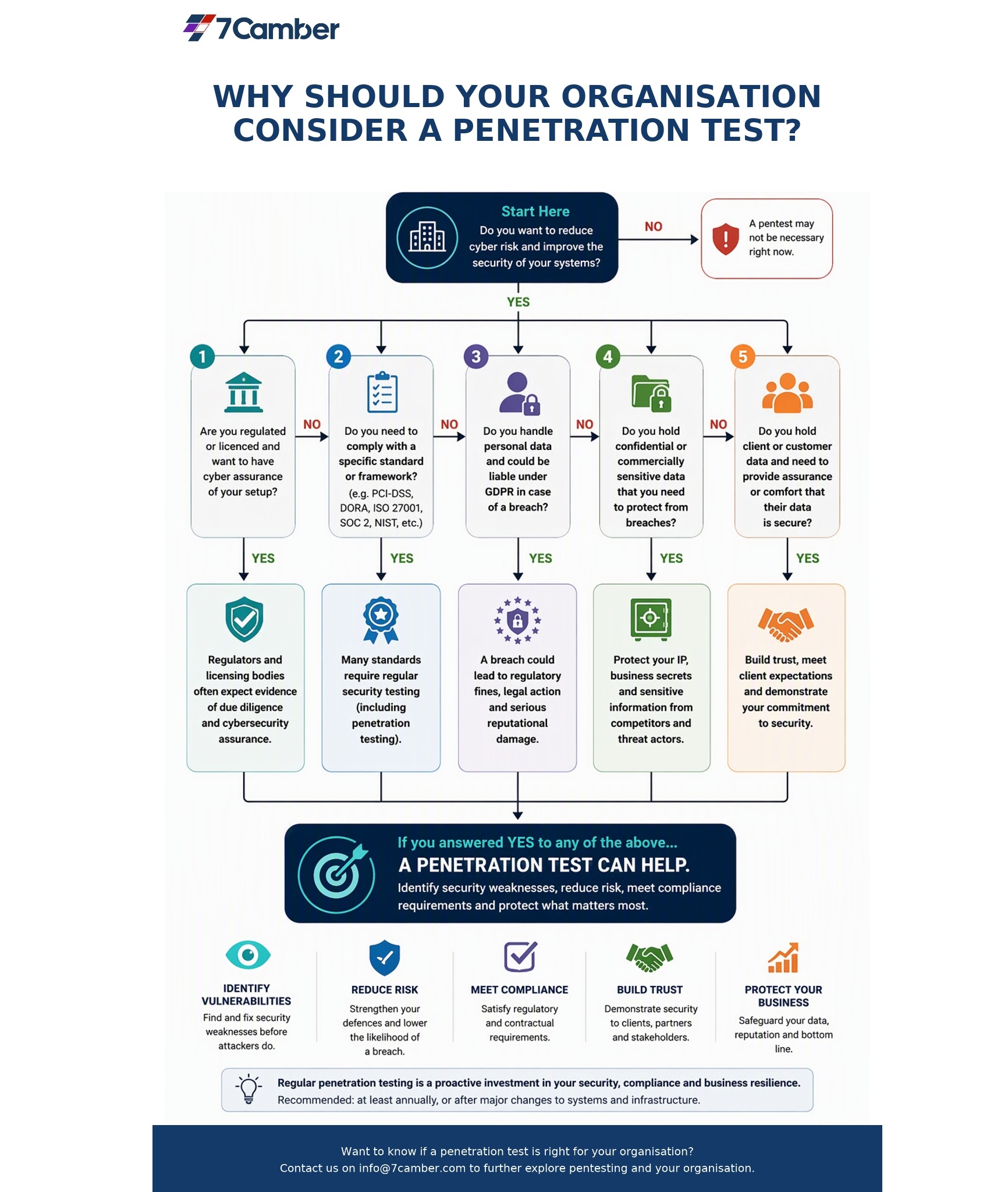
Penetration testing for regulatory compliance
When organisations invest in penetration testing, the goal is usually clear: identify vulnerabilities before attackers do. But in today’s increasingly regulated environment, that’s only part of the story. Regulatory penetration testing services are key.
Security is no longer just about finding weaknesses, it’s about demonstrating control, accountability, and resilience in the eyes of regulators.
This is where many penetration testing providers fall short.
7Camber approaches penetration testing differently. While deeply technical, the firm also brings a clear understanding of how regulators think, what they expect, and how businesses can meet those expectations without unnecessary complexity. This dual perspective is what sets 7Camber apart and why it matters more than ever. Regulatory penetration testing services make all the difference.
The Shift: From Pure Security to Regulatory Accountability
Cybersecurity is no longer just an IT issue. Across industries, especially in financial services, insurance, and regulated sectors, security is now a board-level concern. Regulators are increasingly focused on:
- Evidence of robust security controls
- Demonstrable risk management processes
- Clear audit trails and documentation
- Ongoing testing, not one-off exercises
Regulatory penetration testing services play a central role in all of this. But simply running tests and delivering a list of vulnerabilities is no longer enough. Organisations need penetration testing that:
- Aligns with regulatory frameworks
- Supports compliance reporting
- Helps demonstrate governance and control maturity
- Stands up to scrutiny during audits and reviews
This is the gap 7Camber is designed to fill.
Not All Penetration Testing Is Created Equal
Many penetration testing firms are highly skilled at uncovering vulnerabilities. However, their outputs are often designed for technical teams rather than regulators, auditors, or senior stakeholders. This can create a disconnect:
- Technical findings may not map clearly to regulatory requirements
- Reports may lack the context needed for compliance narratives
- Remediation advice may not align with risk frameworks
- Testing may not reflect real-world regulatory expectations
In contrast, 7Camber ensures that every engagement delivers value across both technical and compliance dimensions.
A Dual Perspective: Technical Depth Meets Regulatory Understanding
At its core, 7Camber is a technical security firm. Its specialists are experienced penetration testers, capable of identifying complex vulnerabilities across infrastructure, applications, and systems.
But what makes the firm distinctive is its ability to interpret these findings through a regulatory lens.
What does that mean in practice?
It means:
- Testing methodologies aligned with regulatory expectations
- Reporting tailored to both technical and non-technical audiences
- Clear mapping of vulnerabilities to risk categories and controls
- Remediation guidance that supports compliance as well as security
This approach ensures that penetration testing is not just an isolated technical exercise, but a meaningful part of a broader risk and compliance strategy.
Why Regulatory Awareness Matters
1. Better Alignment with Compliance Frameworks
Regulators expect organisations to follow defined frameworks and standards. These may include internal risk models, industry guidelines, or formal regulations.
A penetration test that doesn’t align with these frameworks can create unnecessary work:
- Teams must reinterpret findings
- Gaps in reporting need to be filled manually
- Additional testing may be required
7Camber addresses this by structuring testing and reporting in a way that naturally aligns with regulatory expectations, reducing friction and duplication.
2. Stronger Audit Readiness
Audits and regulatory reviews are often high-pressure events. Organisations need to demonstrate not only that testing has been conducted, but that it was:
- Thorough
- Relevant
- Actioned appropriately
7Camber’s approach supports this by delivering outputs that are:
- Clear and well-structured
- Evidence-based
- Easy to present to auditors and regulators
This can significantly reduce the burden on internal teams during audits.
3. Clear Communication Across Stakeholders
One of the biggest challenges in security is communication. Technical teams, risk functions, and senior leadership often speak different languages. A highly technical penetration test report, while valuable, may not be easily understood outside the IT function.
7Camber bridges this gap by:
- Translating technical findings into business risk
- Providing clear summaries for non-technical stakeholders
- Structuring reports to support decision-making
This ensures that everyone, from engineers to executives, can understand the implications and act accordingly.
4. More Effective Risk Management
Penetration testing should inform risk management, not sit alongside it. By understanding regulatory expectations, 7Camber helps organisations:
- Prioritise vulnerabilities based on real risk
- Align remediation with business impact
- Integrate testing outcomes into risk frameworks
This leads to more focused, effective security improvements.
5. Confidence with Regulators
Ultimately, organisations want confidence that they can stand up to regulatory scrutiny. Working with a provider that understands how regulators think can make a significant difference. It enables organisations to:
- Demonstrate a mature approach to security testing
- Show alignment with expectations
- Provide clear, credible evidence of controls
This is not just about avoiding issues, it’s about building trust.
The 7Camber Approach
7Camber’s services cover a wide range of penetration testing needs, reflecting the complexity of modern environments. These include:
- Infrastructure penetration testing
- Web application testing
- Cloud security assessments
- API testing
- Red teaming and advanced simulation exercises
But regardless of the specific service, the underlying principles remain consistent:
- Context Matters – Testing is designed to reflect real-world risk and regulatory context—not just theoretical vulnerabilities.
- Clarity is Key – Findings are presented in a way that is both technically accurate and easy to understand.
- Action drives value – Reports focus on what needs to be done, not just what is wrong.
- Compliance is integrated – Outputs are aligned with regulatory expectations from the outset.
Moving Beyond the “Tick Box” Approach
One of the risks in regulated environments is that security activities become checkbox exercises completed to satisfy requirements rather than improve security. 7Camber actively works against this mindset. By combining technical expertise with regulatory awareness, the firm helps organisations move towards:
- Meaningful testing that reflects real threats
- Insights that drive improvement
- Reporting that adds value beyond compliance
This creates a more mature and sustainable security posture.
Who Benefits Most from This Approach?
While all organisations can benefit from regulatory-focused penetration testing, it is particularly valuable for:
- Financial Services Organisations – Where regulatory scrutiny is high and expectations are constantly evolving.
- Growing Companies Entering Regulated Markets – Who need to quickly demonstrate compliance capability.
- Organisations Facing Regular Audits – Where clear, defensible evidence is essential.
- Businesses with Complex Technology Environments – Where technical findings need to be translated into business risk.
A Partner, Not Just a Provider
Perhaps the most important distinction is this:
7Camber doesn’t position itself as just a testing provider.
It acts as a partner, one that understands both the technical challenges of cybersecurity and the broader context in which organisations operate.
This means:
- Engagements are collaborative, not transactional
- Outputs are tailored, not generic
- Value extends beyond the test itself
For organisations navigating complex regulatory environments, this partnership approach can make a real difference.
Final Thoughts
Penetration testing remains a critical component of any cybersecurity strategy. But in today’s regulatory landscape, technical excellence alone is not enough. Organisations need testing that:
- Identifies vulnerabilities
- Supports compliance
- Enhances risk management
- Builds confidence with regulators
7Camber delivers on all of these fronts. By combining deep technical capability with a clear understanding of regulatory expectations, the firm provides a more complete, more effective approach to penetration testing.
It’s not just about finding flaws. It’s about helping organisations demonstrate control, improve resilience, and meet the demands of an increasingly complex world.