Why Your Business Needs a Penetration Test
Cyber threats continue to evolve, becoming more sophisticated and more costly for organisations of all sizes. Yet many businesses still struggle to answer a simple question: Do we really need a penetration test?
The answer often becomes clear when you look beyond cybersecurity and focus on what is at stake: customer trust, regulatory compliance, sensitive data, intellectual property, and business continuity.
A penetration test, often called a pentest, is a controlled and authorised security assessment designed to identify vulnerabilities before cybercriminals can exploit them. Rather than waiting for attackers to find weaknesses, organisations take a proactive approach to discover and fix them first.
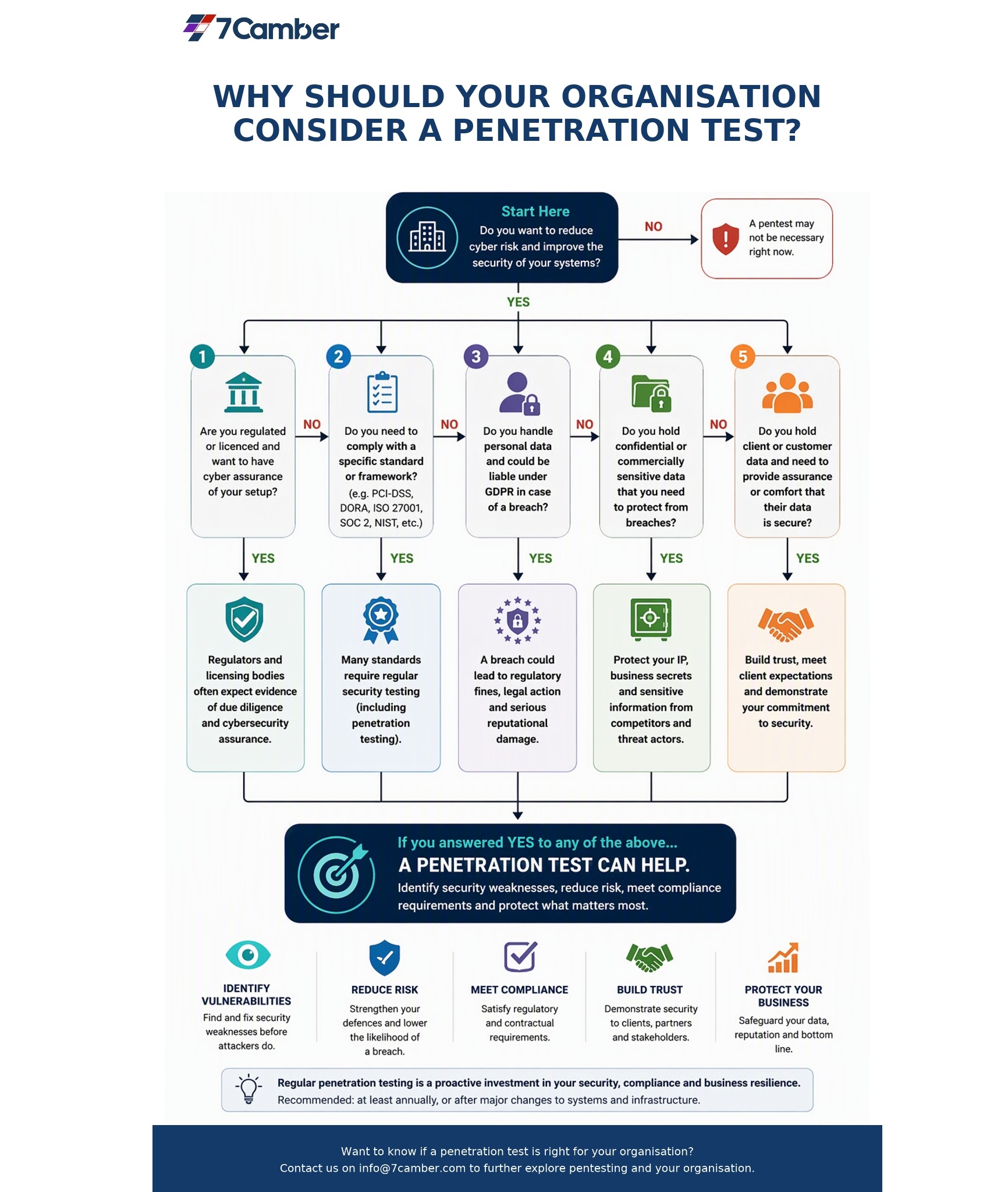
If any of the following situations apply to your business, a penetration test should be high on your priority list.
1. You Operate in a Regulated or Licensed Industry
Many organisations work within industries that face increasing scrutiny from regulators and licensing bodies. Whether you operate in financial services, healthcare, technology, legal services, or critical infrastructure, demonstrating robust cybersecurity practices is becoming a baseline expectation.
A penetration test provides evidence that your organisation is actively assessing and improving its security posture. This demonstrates due diligence and shows stakeholders that cybersecurity risks are being managed appropriately.
For regulated organisations, security assurance is not just good practice. It is often a business or regulatory requirement.
2. You Need to Meet Compliance Requirements
Compliance frameworks increasingly require organisations to demonstrate effective security controls.
Standards and frameworks such as:
- PCI DSS
- ISO 27001
- DORA
- SOC 2
- NIST Cybersecurity Framework
often include requirements for security testing, vulnerability management, or penetration testing.
A professionally conducted penetration test helps organisations validate their controls, identify gaps, and provide auditors with evidence that security risks are being actively managed.
Importantly, compliance should never be viewed as a tick-box exercise. A penetration test can uncover real-world weaknesses that automated scans and documentation reviews may miss.
3. You Process Personal Data
If your organisation stores, processes, or transmits personal information, the consequences of a data breach can be severe.
Data protection regulations such as GDPR place clear responsibilities on organisations to protect personal data. Failure to do so can lead to regulatory investigations, financial penalties, legal action, and reputational damage.
Cybercriminals actively target organisations holding valuable personal information because it can be used for fraud, identity theft, and other criminal activities.
A penetration test helps identify vulnerabilities that could expose sensitive information, allowing security teams to address issues before they result in a breach.
In many cases, the cost of prevention is significantly lower than the cost of responding to a successful attack.
4. You Hold Commercially Sensitive Information
Not all valuable information is personal data.
Many organisations rely on proprietary information that gives them a competitive advantage. This may include:
- Intellectual property
- Product designs
- Research and development data
- Strategic business plans
- Financial information
- Trade secrets
If attackers gain access to this information, the financial and competitive impacts can be substantial.
A penetration test evaluates how effectively your systems protect these assets and helps uncover weaknesses that could allow unauthorised access.
Protecting commercially sensitive information is about more than cybersecurity. It is about protecting the future value of your business.
5. Your Customers Expect Assurance
Trust has become one of the most valuable assets any organisation can possess.
Customers, partners, suppliers, and investors increasingly want confidence that their information is secure. Security questionnaires, supplier assessments, and due diligence reviews are now common parts of the procurement process.
A recent penetration test demonstrates that your organisation takes cybersecurity seriously and invests in protecting stakeholder data.
This can provide a competitive advantage when bidding for contracts, onboarding new customers, or strengthening existing business relationships.
In many industries, cybersecurity has evolved from an IT concern into a board-level business issue.
The Business Benefits of Penetration Testing
While organisations often begin penetration testing to satisfy a regulatory or customer requirement, the benefits extend far beyond compliance.
A penetration test can help your organisation:
- Identify Vulnerabilities – Discover weaknesses in systems, applications, and infrastructure before attackers do.
- Reduce Cyber Risk – Address critical vulnerabilities and strengthen your overall security posture.
- Meet Compliance Obligations – Support audits, regulatory requirements, and contractual commitments.
- Build Customer Trust – Demonstrate a commitment to protecting sensitive information.
- Protect Your Business – Safeguard your data, reputation, operations, and bottom line.
Why Regular Testing Matters
Cybersecurity is not a one-time project.
Networks change. New applications are deployed. Employees join and leave. Cloud environments evolve. Threat actors continually develop new attack techniques.
As a result, a penetration test completed several years ago provides little assurance about your current security posture.
Most organisations should consider penetration testing at least annually. Additional testing should be performed following significant infrastructure changes, major application updates, mergers and acquisitions, or the introduction of new technologies.
Regular testing provides assurance that security controls continue to perform as expected in an ever-changing threat landscape.
Final Thoughts
When organisations consider penetration testing, the conversation often starts with cybersecurity. However, the real value extends far beyond technical vulnerabilities.
Penetration testing helps reduce risk, support compliance, protect sensitive information, strengthen customer confidence, and improve business resilience.
If your organisation is regulated, handles personal data, stores commercially sensitive information, or wants to demonstrate a commitment to security, the question is not whether a penetration test can provide value.
The real question is whether you can afford not to know where your vulnerabilities exist before an attacker does.