If you ask most business leaders whether their organisation is secure, they’ll usually say yes. They’ve invested in tools, their IT team is competent, and auditors haven’t raised any major red flags. But in reality are there any cybersecurity myths that silently put businesses at risk?
But here’s the uncomfortable reality:
Most cybersecurity incidents in 2026 will come from the blind spots organisations didn’t even know they had.
These blind spots often trace back to a set of dangerous myths that have quietly embedded themselves into business culture: Myths that feel true, sound logical and that cost companies millions.
Based on 7Camber’s extensive global experience delivering penetration testing and cyber‑resilience services across 20+ countries and heavily regulated sectors, these are the five beliefs causing the most damage today.
Let’s break them down and explore how organisations can turn these risky assumptions into actionable resilience.
Myth 1: “We Use Security Scanners, So We’re Covered.”
Automated tools are essential, but they are nowhere close to enough.
Scanners can flag known vulnerabilities and configuration issues. What they cannot do is think creatively, chain weaknesses together, or exploit business logic flaws. They cannot understand intent, manipulate workflows, or pivot between systems the way a real attacker would.
This is where the gap becomes dangerous.
What 7Camber’s testing repeatedly uncovers:
- Vulnerabilities hidden behind authenticated flows
- API logic issues that scanners completely miss
- Misconfigurations in cloud or network environments
- Weaknesses that only appear when several low‑risk issues are chained together
This is consistent with 7Camber’s positioning as a manual, expert‑driven penetration testing provider, delivering clarity far beyond automated scanning.
Why this myth persists
Because scanners create the illusion of safety by creating a perception that a clean report is equivalent to a safe company.
But real attackers don’t behave like scanners. They behave like adversaries.
The fix:
Regular manual penetration testing, not just tooling. Expert testers uncover real attack paths that scanners cannot see.
Myth 2: “We’re a Small Target — Hackers Won’t Bother With Us.”
This is one of the most persistent, and most dangerous, assumptions.
Factually, smaller organisations are attacked more frequently. Why? Because:
- They often lack full‑time security staff
- Their defensive tooling is simpler
- Their vendors, APIs, and outsourced services increase exposure
- They are easier to monetise (ransomware, credential reuse, fraud)
And in regulated industries like fintech, payments, and gaming, all common sectors 7Camber serves, attack frequency is even higher.
The real risk
Attackers seldom start with big banks or enterprises. They go after the smallest link in the chain, often a service provider, SaaS platform, or small financial entity. Once compromised, they pivot upstream to larger targets.
The fix:
Treat cybersecurity as a risk multiplier, not a company‑size issue. Even small entities need security testing aligned to their exposure.
Myth 3: “Internal Networks Are Safe — The Threat Is Outside.”
Another outdated assumption that attackers exploit daily.
Yes, external threats grab the headlines. But internal networks, especially hybrid and distributed environments, are often where attackers do the most damage.
7Camber consistently identifies weaknesses such as:
- Flat internal networks
- Outdated internal services
- Over‑permissive credentials
- Exposed file shares
- Weak internal segmentation
Why internal threats are rising
- Remote work increases lateral movement opportunities
- Compromised credentials are now the #1 initial access method
- Third‑party integrations bypass perimeter controls
- Cloud and on‑prem hybrids expand the internal attack surface
Attacks like ransomware heavily rely on internal propagation — not just initial compromise.
The fix:
Run internal network penetration tests to identify pivot paths before attackers do. Don’t assume “inside = safe.”
Myth 4: “Compliance Means We’re Secure.”
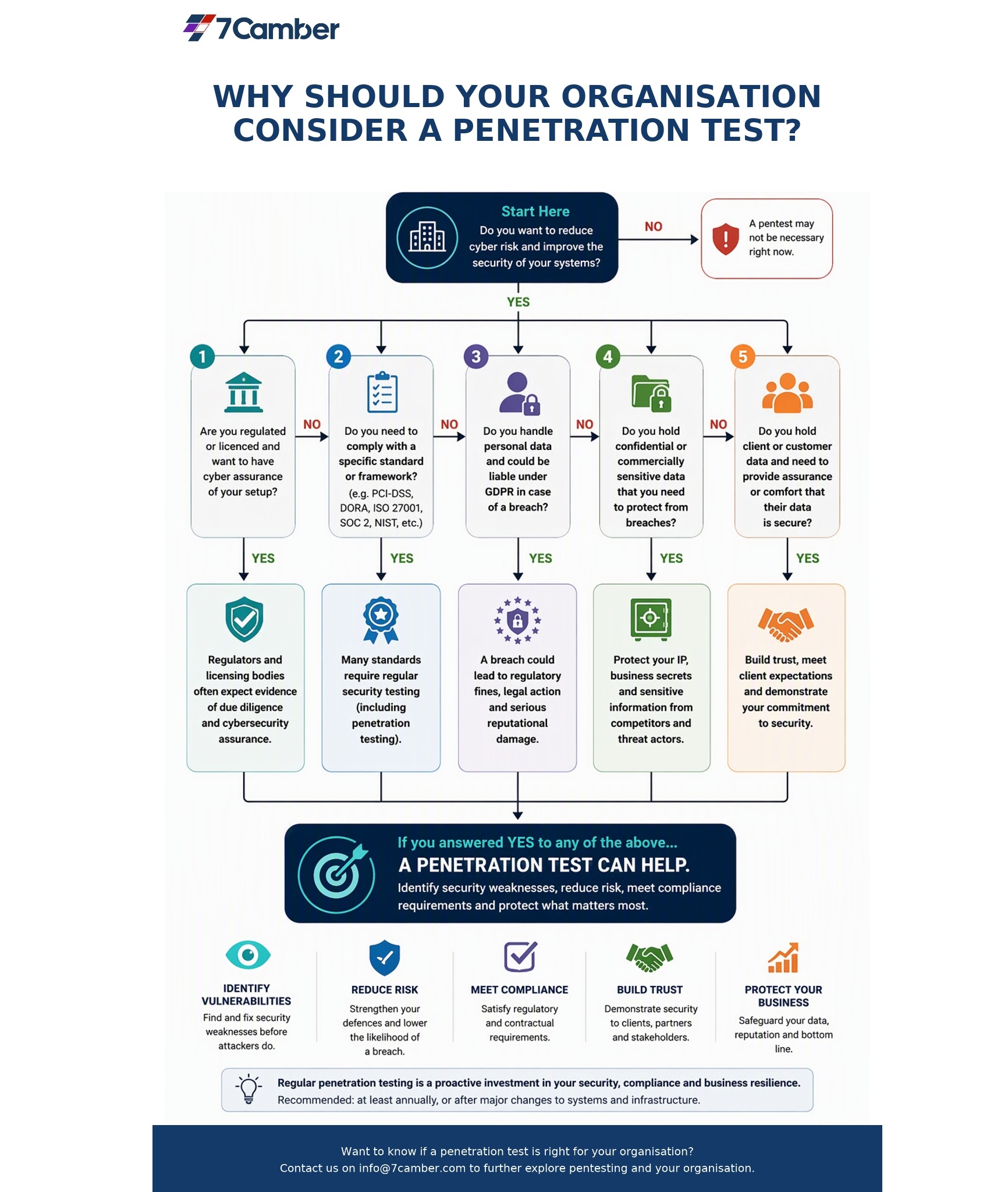
Compliance frameworks such as PCI‑DSS, ISO 27001, DORA TLPT, and TIBER‑EU are essential. But compliance ≠ security. In fact, regulators themselves stress this distinction.
For example:
- PCI‑DSS requires annual penetration testing as a minimum baseline.
- DORA TLPT, effective January 2025 for EU financial entities, requires threat‑led testing, not checklist compliance.
- TIBER‑EU explicitly mandates intelligence‑driven red teaming against live critical systems.
Compliance frameworks define the floor, not the ceiling, of security expectations.
Why this myth is so dangerous
Compliance-driven teams often stop at the bare minimum:
- “We passed the audit.”
- “We have the policy.”
- “We filled the checklist.”
But attackers don’t care about checkboxes. They care about vulnerable systems, weak credentials, exposed APIs, misconfigured cloud assets, and unpatched internal services.
The fix:
Move from audit readiness to operational resilience:
- PCI pentests verify real risks
- ISO alignment strengthens governance
- DORA TLPT and TIBER‑EU simulate real adversaries
7Camber specialises in all these testing frameworks across multiple geographies, making it one of the few boutique companies capable of handling regulated and elective testing under one roof.
Myth 5: “We Would Know If We Were Breached.”
This assumption is the most costly.
Here’s the truth: Most organisations discover breaches months after they occur — often through third parties, not their own monitoring.
Even mature companies fail to detect:
- Lateral movement
- Credential harvesting
- Stealthy privilege escalation
- Infrastructure probing
- Malicious API calls
- Covert data extraction
Detection requires continuous monitoring and tested response playbooks.
But unless detection capabilities are tested under real‑world pressure, they remain theoretical.
This is where red teaming becomes essential
7Camber provides real-world attack simulations, designed to test both technical and human controls, including detection, response, and escalation processes.
Frameworks like TIBER‑EU formalise this approach by requiring intelligence‑led adversary simulations on production systems.
The fix:
Test detection capabilities through:
- Red team exercises
- Threat‑led penetration tests
- Scenario-based attack simulations
If you want to know whether you’d detect a real attacker, simulate one.
Where These Myths Come From — And Why They Still Persist
Business leaders aren’t ignoring security — they’re trying to interpret it in a complex world. The issue is that cybersecurity evolves faster than organisational culture. That is why these cybersecurity myths put businesses at risk.
Across the 15+ years of global experience within the 7Camber team, a pattern shows up repeatedly:
Companies are working hard, but they’re working on the wrong assumptions.
Part of the problem is the flood of tools and vendors promising easy fixes, another is compliance fatigue. Part is the false reassurance of “no incidents reported.”
But the biggest cause? Cybersecurity feels abstract until the day it becomes painfully real.
This is why clear, actionable, business-friendly communication is central to 7Camber’s mission: turning technical findings into decision-making insights.
How Organisations Can Move Beyond These Myths in 2026
1. Shift from assumptions to evidence
Run regular manual penetration tests — not just vulnerability scans.
2. Focus on business logic and API testing
APIs are the fastest-growing attack surface, and scanners consistently miss logic flaws.
3. Treat internal networks as high-risk environments
Modern attacks thrive on lateral movement.
4. Separate compliance from security
Ensure regulatory testing (PCI, ISO, DORA, TIBER‑EU) is coupled with continuous resilience practices.
5. Test your detection capabilities
Red team exercises expose gaps that SIEM dashboards do not.
6. Work with a specialist testing partner
7Camber combines:
- Regulatory expertise
- Technical depth
- Clear communication
- Tailored testing based on risk appetite
These strengths make it particularly effective for highly regulated and fast-moving industries like fintech, payments, and gaming.
Conclusion: Security Doesn’t Fail Because of Hackers — It Fails Because of Assumptions
Every one of these cybersecurity myths that put businesses at risk is rooted in good intentions: efficiency, trust, optimism, or the desire to simplify. But attackers don’t operate based on myths. They operate based on reality.
The organisations that thrive in 2026 will be the ones that challenge assumptions and replace them with evidence.
And that begins with expert-led, human-driven penetration testing.