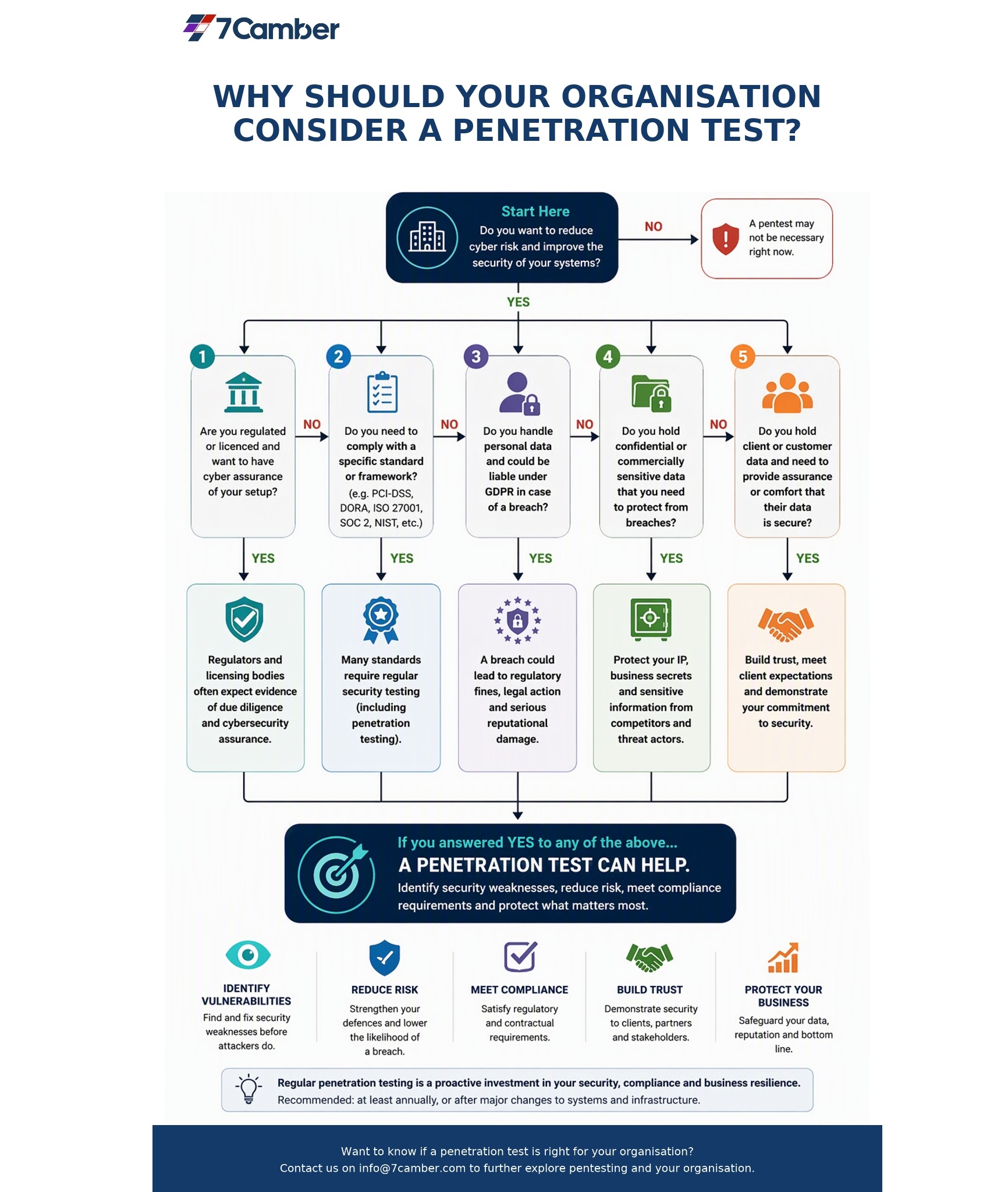
Penetration testing has become one of the most talked‑about topics in modern cybersecurity. Regulators expect it. Boards ask about it. Security teams plan for it. Vendors promote it relentlessly.
So let’s take a step back and ask an uncomfortable question:
Are there reasons not to carry out a penetration test?
The honest answer is yes. There are reasons people delay, avoid, or deprioritise penetration testing every day. Some sound reasonable. Some feel practical. Others are rooted in experience, budget pressure, or fear of disruption.
But here’s the critical part: most of those reasons sound sensible on the surface, yet break down completely when examined through a real‑world lens, especially in environments shaped by regulatory pressure, cloud dependency, APIs, and increasingly sophisticated attackers.
Drawing on years of hands‑on testing, regulatory work, and lessons reinforced by specialist firms such as 7Camber, a penetration testing provider supporting organisations across more than 20 countries, let’s walk through seven of the most common reasons people give for not carrying out a penetration test, and unpack what they really mean in practice.
1. “We already passed our audit”
This is one of the most common, and most dangerous, reasons that organisations use to avoid penetration testing.
Passing an audit feels reassuring. PCI‑DSS, ISO 27001, DORA, SOC reports all deliver a sense of closure. A stamp that says compliant. For many businesses, that feels like enough.
The problem, however, is that audits and penetration tests are not the same thing.
Audits assess whether controls exist and whether processes align with a framework. Penetration tests assess whether those controls actually work under attack. A system can be perfectly documented, fully compliant, and still trivially exploitable in practice, a reality repeatedly observed during regulatory and elective penetration tests alike.
Relying solely on audits assumes attackers respect documentation and policy. They do not. They exploit misconfigurations, chained weaknesses, and real‑world process gaps that audits are not designed to uncover.
If “we passed the audit” is the reason not to test, it often means the organisation is confusing governance with resilience.
2. “Penetration testing is too expensive”
Budget pressure is real. Security budgets compete with product development, operations, and regulatory initiatives. It’s easy to view penetration testing as a discretionary cost, especially when nothing has gone wrong yet.
But this reasoning only works if you ignore the cost side of risk.
A single security incident: ransomware, data leakage, regulatory breach; almost always costs more than multiple years of structured penetration testing. Downtime, legal fees, regulatory fines, customer churn, executive distraction, and reputational damage compound quickly.
Organisations working with experienced penetration testing teams often discover that targeted, risk‑driven testing delivers far more value than broad, unfocused security spending. Modern providers tailor scope to business priorities, regulatory drivers, and threat exposure rather than pushing one‑size‑fits‑all exercises.
The question is rarely “Can we afford to test?”
It is far more often “Can we afford not to?”
3. “Our environment is too complex”
Hybrid infrastructure. Cloud platforms. APIs. Third‑party integrations. Legacy systems you would rather forget about. Complexity has become the norm.
Many organisations delay penetration testing because they believe their technology estate is “too complicated” to test effectively, or they fear the results will be overwhelming.
Ironically, complexity is exactly why penetration testing is needed.
Attackers thrive in complex environments. They exploit the seams between systems, assumptions between teams, and gaps created by rapid growth. APIs expose business logic. Cloud misconfigurations create invisible entry points. Internal networks quietly accumulate privilege risks over time.
Experienced testing teams break large estates into manageable, business‑aligned scopes; focusing effort where risk actually lives rather than attempting to test everything at once.
Avoiding testing because an environment is complex doesn’t reduce risk. It simply ensures that complexity remains untested and unchallenged.
4. “We don’t want to break anything”
This concern is deeply understandable. Production systems keep the business running. Fear of outages, data corruption, or customer disruption deters many organisations from authorising tests.
The misconception here is that penetration testing is chaotic or reckless.
Professional penetration testing is structured, controlled, and rule‑driven. Scope boundaries are agreed. Fail‑safes are defined. Real‑world attack techniques are used responsibly and proportionately. Experienced testers are trained to observe system behaviour, monitor impact, and stop long before damage occurs.
Ironically, issues uncovered during testing, weak segregation, unsafe failovers, fragile assumptions, often reveal operational risks that could cause outages without any attacker involved.
Avoiding tests to “protect stability” can blind an organisation to the very weaknesses that threaten it most.
5. “We already run vulnerability scans”
Automated scanning tools are valuable. They find missing patches, common misconfigurations, and known weaknesses at scale. Many organisations rely heavily on them and view penetration testing as redundant.
But scanners do not think like attackers.
They do not chain vulnerabilities; they do not test logic flaws; they do not abuse workflows, permissions, or trust relationships. They do not creatively bypass controls or exploit business assumptions.
Penetration testing complements scanning by answering a different question: “Given these weaknesses, what could someone actually do?”
Across web applications, APIs, networks, and cloud platforms, real‑world exploitation often hinges on how small issues combine, and not whether a single high‑severity CVE exists.
When organisations skip penetration testing because they already scan, they confuse signal generation with risk validation.
6. “We trust our developers and IT team”
Strong internal teams are a competitive advantage. Skilled engineers, DevOps staff, and security professionals work hard to build resilient systems.
But trust is not a control.
Even the best teams operate under time pressure, shifting priorities, and human limitation. Modern systems depend heavily on third‑party components, cloud defaults, frameworks, and inherited design decisions. Vulnerabilities are rarely introduced through incompetence; they emerge through reasonable choices made under constraints.
Penetration testing is not about blame. It is about perspective. An external testing team approaches systems without institutional assumptions and with attacker thinking at the forefront, a viewpoint internal teams cannot fully replicate while also building and operating services.
Ironically, the organisations most confident in their teams often gain the most value from testing because findings are quickly understood, prioritised, and fixed.
7. “No one would target us”
This belief quietly underpins many security decisions and many security failures.
Modern attacks are rarely personal. Automated scanning, credential stuffing, bot exploitation, and supply‑chain compromise do not require a reason to target you. Exposure is enough.
Attackers do not ask whether an organisation is important. They ask whether it is available, vulnerable, and worth minimal effort.
Organisations across professional services, eCommerce, fintech, gaming, manufacturing, and logistics increasingly discover they are part of someone else’s attack path, useful as an entry point, pivot, or data source.
Avoiding penetration testing because “we’re unlikely to be targeted” assumes a threat model that no longer exists.
Final Thoughts: The Real Reason People Avoid Penetration Testing
If we are honest, the real reason penetration testing is avoided is rarely technical or financial.
It is discomfort.
Testing challenges assumptions. It creates evidence. It replaces “we think” with “we know”. And that can feel risky, especially when results may demand change.
Organisations that work with experienced penetration testing partners, such as 7Camber, tend to find that the greatest value is not the vulnerabilities uncovered, but the clarity gained: clearer risk ownership, clearer prioritisation, and clearer conversations between technical teams and decision‑makers.
The seven reasons not to carry out a penetration test sound convincing. Until reality gets involved.