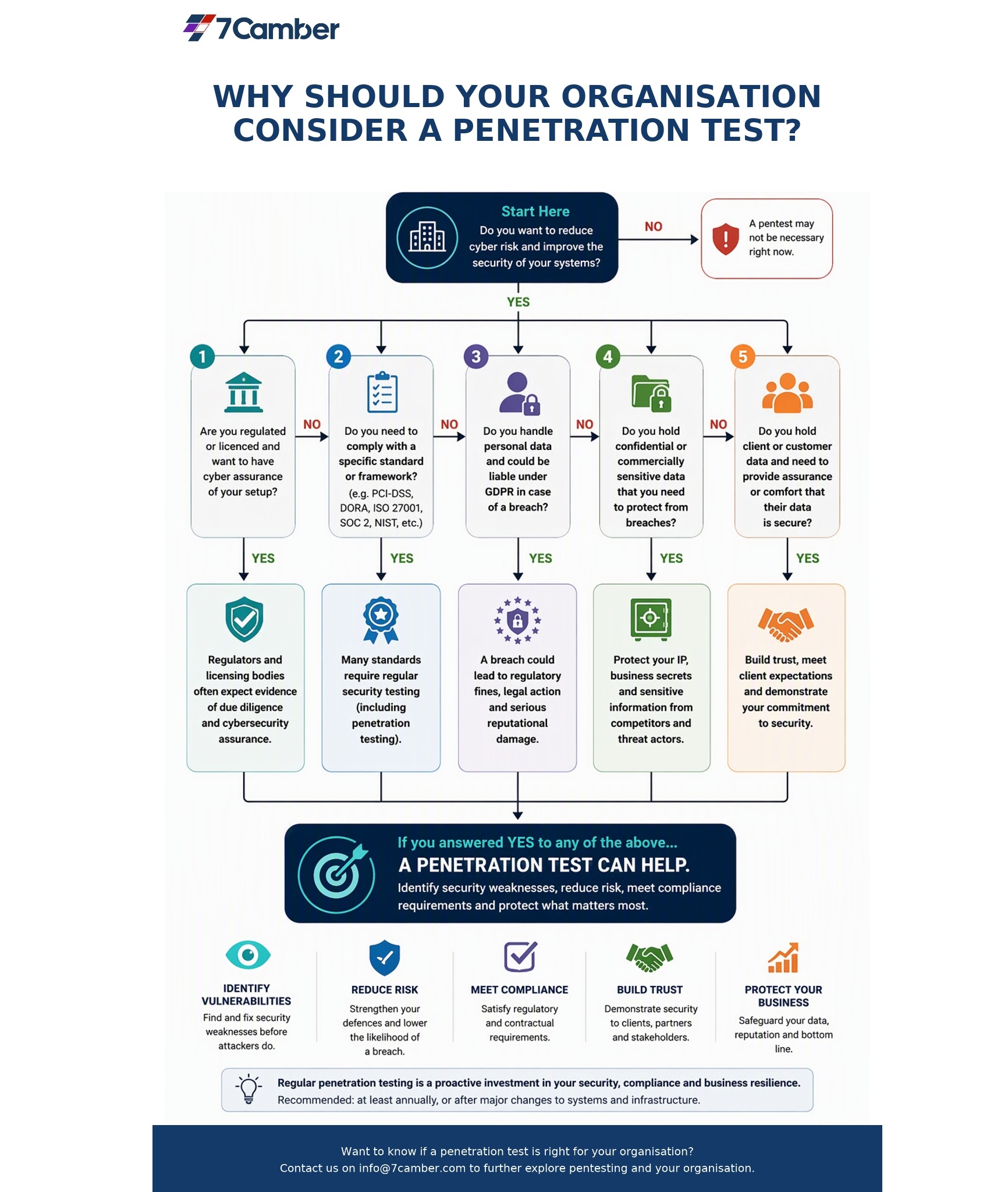
“No Public-Facing Services = secure”?
When a business leader states with confidence, “We do not need penetration testing since we have no public-facing services,” it reveals a mindset shaped by an outdated understanding of cybersecurity. It assumes that cyber risk begins at the internet edge and that removing visible entry points is enough to deter modern attackers.
This assumption is not only flawed, it is dangerous.
In today’s digital landscape, organisations no longer define security by what they expose; instead, they must focus on what others can access—and recognise that access points extend far beyond what they are willing to acknowledge.
Security Is Not Defined by Visibility
The traditional model of cybersecurity centred on a defined perimeter, creating a clear boundary that separates trusted internal systems from untrusted external threats. Organisations used firewalls, gateways, and restricted access points to reinforce and protect this boundary.
However, digital transformation has dismantled this model.
Modern organisations rely on:
- Cloud infrastructure
- Remote workforces
- Third-party integrations
- API-driven ecosystems
- Constant data exchange
These realities have blurred the lines between internal and external environments. The notion of a sealed internal network is largely fictional.
Even without public-facing services, organisations still:
- Allow employees to access systems remotely.
- Use email and collaboration platforms.
- Integrate with external suppliers and partners.
- Depend on internet-based services.
Each of these creates a potential entry point, one that does not require a public website or application.
The absence of public exposure does not eliminate risk. It merely shifts it into less visible, and often less monitored, areas.
The Real Attack Surface: Connectivity and Access
A critical misunderstanding in many organisations is confusing exposure with connectivity.
While public-facing services represent one form of exposure, the true attack surface depends on who or what can access your systems and under what conditions.
Consider the following:
- An employee laptop connects to internal systems via VPN from an unsecured network.
- A third-party vendor has administrative access for maintenance.
- A cloud platform stores sensitive data with misconfigured permissions.
- An application relies on APIs that authenticate using weak or reusable tokens.
None of these require a public-facing service to be exploited.
An attacker does not need an open front door if they can walk in through a side entrance disguised as a trusted user.
How Modern Attacks Actually Happen
The idea that attackers primarily exploit publicly accessible systems is increasingly outdated. In reality, many successful attacks follow a different pattern:
- Initial Access – Gained through phishing, credential theft, or compromised endpoints.
- Establish Foothold – Attacker operates within the network using legitimate access channels.
- Lateral Movement – Systems are explored, and access is expanded through weak segmentation or misconfigured permissions.
- Privilege Escalation – Higher levels of access are obtained, often via overlooked vulnerabilities.
- Data Access or Disruption – Sensitive data is accessed, exfiltrated, or systems are disrupted.
At no point in this chain is a public-facing service strictly required. This is precisely why penetration testing remains critical, even in environments with minimal external exposure.
Industry Examples: Risk Without Public Exposure
Professional Services: The Risk of Trust
Professional services firms often operate with limited public-facing infrastructure. Their primary assets: client data, legal documents, intellectual property; are typically stored internally.
Yet, their operational model depends heavily on:
- Email communications.
- File-sharing platforms.
- Remote access.
A compromised user account can unlock extensive access due to implicit trust within the organisation.
For example:
- An attacker successfully phishes an employee.
- They gain access to email and shared drives.
- Sensitive client data is accessed or exfiltrated.
No public-facing services are involved. The vulnerability lies in identity and trust not visibility.
Financial Services: Complexity Creates Opportunity
Financial institutions often restrict external exposure, especially around core systems. However, their internal ecosystems are highly complex.
These environments frequently include:
- Legacy platforms.
- Interconnected applications.
- Multiple privilege tiers.
Weak segmentation or excessive access rights can allow an attacker to move freely once inside.
A single compromised endpoint may lead to:
- Access across multiple systems.
- Privilege escalation.
- Exposure of sensitive financial data.
The risk stems from architecture not internet exposure.
Fintech: The Illusion of Controlled Exposure
Fintech firms may believe they are secure due to limited traditional exposure. However, they are deeply reliant on cloud platforms and APIs.
Common risks include:
- Misconfigured storage services.
- Weak identity management controls.
- Exposed or poorly secured APIs.
These vulnerabilities are often indirect, meaning they are not immediately visible but still accessible.
An attacker might:
- Discover a misconfigured cloud environment.
- Exploit authentication weaknesses.
- Access sensitive data without breaching any “public” system.
This highlights a crucial truth: exposure is not always obvious.
Service Industries: Hidden Access Points
Operational environments such as logistics or utilities often maintain minimal public-facing systems, yet we see them rely heavily on highly connected internal networks.
Risks frequently arise from:
- Remote access to equipment.
- Weak IT and operational technology separation.
- Legacy systems with default credentials.
An attacker exploiting one access point could:
- Enter the network.
- Navigate internal systems.
- Disrupt operations.
Again, visibility is not the issue: connectivity is.
Internet Access: The Overlooked Risk Factor
If your organisation can access the internet, then the internet can potentially reach you….. indirectly.
Activities such as:
- Sending and receiving emails.
- Downloading files or updates.
- Accessing online platforms.
- Using cloud-based tools.
… all introduce risk vectors.
These interactions enable:
- Malware delivery.
- Credential harvesting.
- Data exfiltration.
- Remote control mechanisms.
In this context, the internet itself becomes an attack surface even without public-facing services.
The Human Factor: The Most Reliable Entry Point
Technology can be hardened. Systems can be segmented. Access can be restricted. But people remain unpredictable.
Employees:
- Click on convincing phishing emails.
- Reuse passwords.
- Trust familiar branding or communication styles.
Attackers understand this and exploit it relentlessly. A single human error can bypass millions invested in technical controls.
Penetration testing that includes user-based scenarios (such as phishing simulations or credential testing) exposes how vulnerable organisations are to human-centric attacks.
The absence of public systems offers no defence against this reality.
Why Penetration Testing Still Matters
Penetration testing is not about testing what is visible, it is about understanding what is possible.
It challenges assumptions by answering critical questions:
- What happens if an attacker gains initial access?
- How easily can they move across systems?
- Where are the weakest controls?
- How quickly can privileges be escalated?
- Would the attack be detected?
Without testing, these questions remain unanswered and risk remains unquantified.
Penetration testing turns theoretical vulnerabilities into tangible insights.
Reframing the Conversation
Instead of asking, “Do we have public-facing services?” organisations should be asking:
- Who has access to our environment?
- How is that access controlled and monitored?
- What happens if a single account is compromised?
- How resilient are our systems under attack conditions?
These questions reflect an evolved understanding of cybersecurity one that considers access, identity, and behaviour, rather than just exposure.
Invisible Does Not Mean Secure
The belief that a lack of public-facing services equates to safety is not entirely irrational, but it is fundamentally incomplete.
It overlooks the realities of today’s threat landscape:
- Attackers target people as much as systems.
- Internal access is often easier to exploit than external exposure.
- Connectivity creates pathways that bypass traditional defences.
- Complex environments introduce hidden vulnerabilities.
Security is no longer about building higher walls. It is about understanding how easily those walls can be bypassed.
Penetration testing gives you that understanding. It shows you not only where attackers can see you, but also where they can exploit you. In a world where risk thrives in the unseen and the assumed, the greatest danger lies not in what attackers can observe but in what organisations choose not to test.