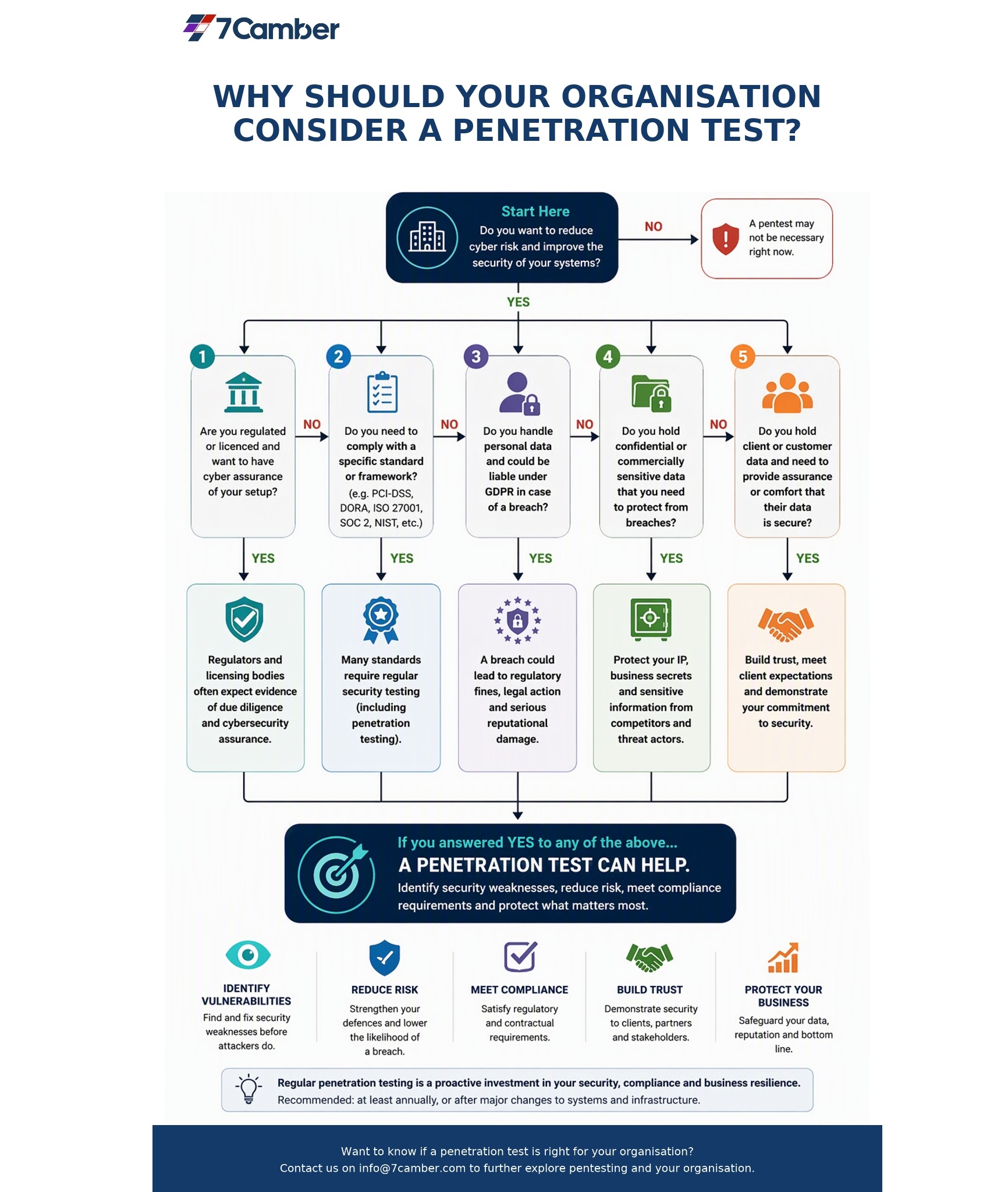
When organisations think about cybersecurity testing, they typically picture penetration tests, red‑team engagements, or vulnerability scans. While these forms of testing are essential, there is another highly effective, and often underestimated, method for strengthening cyber readiness: a cybersecurity tabletop exercise. Unlike hands‑on technical testing, tabletop exercises simulate cyber incidents through guided, scenario-based discussions involving technical and non‑technical stakeholders.
A cybersecurity tabletop exercise explores how people, processes, and technology work together under pressure. They reveal blind spots in decision‑making, communication, escalation, and real-world readiness—areas that even the best pentest cannot fully assess.
Recent analysis by IBM shows that organisations with rehearsed incident response plans saved an average of $2.66M per breach due to faster containment and reduced impact. This underscores a growing reality: as threats accelerate, practising the response is just as important as building the defences.
This post explores what tabletop exercises are, how they work, why they matter, how your clients benefit, and what risks emerge when organisations neglect them.
What is a Cybersecurity Tabletop Exercise?
Tabletop exercises are structured, discussion-based simulations where participants walk through a fictional cyberattack or crisis scenario to test their response capabilities. They are sometimes described as the cybersecurity equivalent of a fire drill, an opportunity to practice before a real disaster strikes.
Unlike red‑team tests or full technical simulations, tabletop exercises are low-pressure, role‑playing activities conducted “around the table”—physically or virtually. Participants take part in guided scenarios that challenge them to:
- Understand what is happening
- Make decisions
- Communicate across teams
- Follow (or discover the gaps in) their incident response procedures
- Coordinate technical and business actions
A cybersecurity tabletop exercise can cover a wide range of threats, including ransomware, phishing, insider threats, supply chain attacks, or disruptions to industrial control systems.
Ultimately, tabletop exercises help answer the critical question:
“When something goes wrong, will our people know what to do?”
How a Tabletop Exercise Typically Works
Although every organisation and facilitator has their unique style, the approach you described mirrors a well-structured process used by cybersecurity leaders worldwide.
1. Discovery & Context Gathering (Live Session)
Before designing a meaningful scenario, the facilitator must understand the client’s environment. This involves a structured discovery session covering:
- Technologies in use
- System architecture
- Security tooling
- Monitoring capabilities
- Business processes
- Operational constraints
- Decision‑making structures
This aligns with common best practices: organisations must base their tabletop scenarios on real risks and realistic infrastructure, not generic templates.
2. Scenario Creation (Client + Facilitator Collaboration)
Clients often propose a scenario. This is excellent practice: when clients choose scenarios, the exercise feels more relevant, urgent, and credible.
Example scenario types may include:
- Ransomware spreading across internal servers
- Zero‑day vulnerability exploited on a public-facing web service
- Cloud authentication compromise
- Vendor supply-chain breach
- Insider sabotage
- Data exfiltration from a financial system
Sources show that scenario realism is one of the strongest predictors of exercise effectiveness.
3. Running the Exercise (The “Dungeon Master” Role)
This is where your style shines. Like a role‑playing game master, you lead participants step‑by‑step through the unfolding storyline:
- Initial incident discovery
- Early indicators and alerts
- What the operations team sees
- How the security team reacts
- New developments introduced gradually (“injects”)
- Evolving impact scenarios
This technique mirrors advanced tabletop models used by major cyber preparedness programs, which introduce ongoing developments to force teams to adapt quickly.
4. Participant Interaction & Decision‑Making
Participants must explain:
- What they would do
- What they would see
- Who they would inform
- What tools they would use
- How they would escalate alerts
- What communication steps they would initiate
- What business decisions they would support
This interactive approach tests the entire response chain—not just the technical side.
5. Assessment & Readiness Evaluation
At the end, you analyse participant responses to gauge:
- Readiness
- Gaps in monitoring
- Weak escalation paths
- Missing documentation
- Communication delays
- Leadership coordination issues
- Misaligned assumptions across teams
- Weaknesses in business continuity or legal response
This is consistent with industry practice: the after‑action review is where the real learning happens.
Why a Cybersecurity Tabletop Exercise is Carried Out
There are several driving reasons why organisations invest in tabletop simulations today.
1. Cyber incidents are inevitable
Organisations now face 1,200 potential security incidents per week, according to global threat data. Attackers are faster, smarter, and more automated than ever before.
2. Technology alone does not guarantee readiness
Multiple sources highlight that even companies with advanced tooling often struggle during actual incidents because they never practised real‑world decision‑making.
3. Incident response is fundamentally a team sport
Tabletop exercises strengthen coordination across IT, security, legal, communications, HR, and executive leadership. This cross‑functional collaboration mirrors national and enterprise‑level best practices.
4. They reveal hidden gaps in policies and processes
The goal is not to “win” the scenario but to uncover weaknesses, such as:
- unclear roles
- missing detection capabilities
- poor communication channels
- slow decision cycles
- inadequate playbooks
- insufficient business continuity processes
5. They prepare leadership for high‑pressure decisions
Executives often underestimate how quickly they may need to decide:
- Whether to shut down systems
- What to disclose to regulators
- Whether to involve law enforcement
- How to manage public communication
- How to preserve business continuity
Tabletop exercises expose these pressures safely and constructively.
Objectives & Goals of a Tabletop Exercise
Though every exercise is different, most share the following objectives.
Testing organisational readiness
- Can teams detect the threat?
- Do they know what to do next?
- Are escalation paths clear?
Validating the incident response plan
Tabletop exercises are a critical tool to validate communication protocols, escalation procedures, and decision‑making frameworks.
Improving communication & coordination
This includes improving communication between:
- technical teams
- business units
- management
- external stakeholders (e.g., law enforcement, insurers)
Training staff
Tabletop exercises build muscle memory—an essential part of effective cyber response.
Identifying gaps
They expose:
- missing capabilities
- outdated processes
- weaknesses in tooling
- unclear responsibilities
- slow recovery plans
- poor documentation
Enhancing executive awareness
Leadership receives a realistic simulation of risk impact, which improves budgeting, prioritisation, and governance.
Value Added to the Client Company
The benefits are substantial and strategically important.
1. Stronger Incident Response Capability
Organisations that consistently run tabletop exercises:
- contain incidents faster
- reduce downtime
- minimise data loss
- coordinate more effectively
As noted earlier, companies with tested IR plans can save millions per breach.
2. Better Cross‑Functional Collaboration
Tabletop exercises bring all stakeholders into one room, enabling:
- shared understanding
- improved alignment
- faster decision-making
- clearer communication routes
This aligns with multi‑disciplinary models used in leading tabletop programs.
3. Enhanced Visibility of Weaknesses
Finding issues during a tabletop exercise is significantly better than discovering them during a breach.
4. Compliance & Regulatory Alignment
Many industries require routine cyber drills and tabletop exercises as part of:
- ISO 27001 compliance
- PCI-DSS incident response requirements
- Cyber insurance conditions
- NIS2 and other regulatory frameworks
5. Improved Team Confidence
Practising gives teams confidence under pressure—a crucial but often overlooked element.
6. Business Continuity & Crisis Management Preparedness
Because tabletops incorporate more than just technical response, organisations better understand:
- legal obligations
- PR and communications
- business impact
- customer support issues
- operational risk factors
Risks of Not Carrying Out Tabletop Exercises
Failing to run tabletop exercises creates serious, often invisible, organisational risk.
1. Delayed Response During Real Incidents
Teams without practice may freeze or improvise, causing delays that worsen impact.
2. Communication Breakdowns
Poorly rehearsed teams often miscommunicate internally or externally, compounding mistakes. This mirrors common real‑world failures reported in incident reviews.
3. Misaligned Priorities Across Departments
IT might prioritise containment, legal might prioritise evidence preservation, executives might prioritise business continuity—and without preparation, these groups can conflict.
4. Hidden Gaps Remain Hidden
Without tabletop exercises, organisations may never discover:
- missing playbooks
- untested escalation paths
- broken dependencies
- outdated contacts
- incomplete monitoring
- insufficient logging
5. Increased Regulatory and Reputational Risk
A poorly handled incident invites:
- regulatory penalties
- litigation
- brand damage
- customer loss
Tabletop exercises reduce these risks dramatically by improving preparedness.
6. Over‑Reliance on Technology
Many companies mistakenly believe tools will handle everything. As highlighted, even highly equipped enterprises may still respond poorly without rehearsal.
Conclusion
Tabletop exercises are one of the most powerful tools an organisation can use to strengthen its cyber resilience. They fill the critical gap between technical testing and real‑world incident response by evaluating what truly matters: how people and processes perform under pressure.
By using realistic scenarios, guiding teams through an evolving storyline, and challenging assumptions like a skilled facilitator (or “dungeon master”), you provide clients with deep insights into their readiness.
With cyber threats intensifying and attackers becoming increasingly sophisticated, tabletop exercises are no longer optional, they are essential. They help organisations:
- make faster decisions
- reduce breach impact
- strengthen communication
- satisfy regulatory expectations
- build confidence
- uncover blind spots
- protect their business, customers, and reputation
In a world where cyber incidents are inevitable, preparation is the best defence.